Monday 31 August 2009

Welcome back, Whitney Houston

I've always loved Whitney. Growing up on her songs was a privilege. Damn, along came Bobby and all turned topsy-turvey. As she faded away, she was missed. In fact, Ann powers sums up well, what Whitney and her voice means to all of us; 'When she was at her best, nothing could match her huge, clean, cool mezzo-soprano -- not Madonna's canny chirp, not Bono's stone church wail nor Bruce Springsteen's ramshackle growl. No, it was Houston who best embodied the feminine but gym-toned, black-inspired but aspirationally post-racial sound of global crossover pop. Like a Trump skyscraper, Houston the singer was as showily dominant as corporate capitalism itself.'

Whitney's back. My first 'listen in' didn't make me go 'wow', but tell you what, there'll be a lot of further listening, and then I know her songs are gonna grow on me.

What's smart about her comeback is her having the entire album streaming live, off her site. Brands taking on the consumer world after a break, or even the first time around need to break the 'stimuli selection barrier'. In a cluttered world where the consumer is bombarded with numerous and varied stimuli, for him to stop, notice and pick a stimuli to respond to, is more than impossible. That even goes for Whitney's new album. To break that barrier, brands must give consumers a compelling reason to stop and consider them. In Whitney's case, its a complete comeback album streaming live, online.

I can't say for sure if I would've bought her comeback album off a music shelf. But what I've done is listen to her online. Listen again. Like now. And as I said before, they're growing on me. Maybe I will consider a buy.

But even if I don't, one thing I promise. I'll be back, online, to listen to her, again.

Welcome back, Whitney.

Sphere: Related Content

Saturday 29 August 2009

Friday 28 August 2009

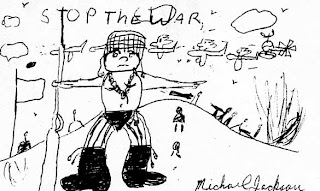
What's Michael's art worth?

'The ink outlines may be crudely etched, the style described as impressionistic, at best. But for fans of Michael Jackson, the pose struck by the figure in the foreground is unmistakable. The picture, drawn by a 13-year-old Jackson in 1971 as a protest against the Vietnam War, shows troops taking a hill, backed up by blazing aircraft. It is to be included in an official book documenting the singer’s life, and can be published for the first time today.'

Its pertinent to note two interesting phenomenon. One, the interpretation of stimulus selected by any receiver may be driven by his prior expectation. That is, the viewer sees what he intends to see. The listener hears what he intends to. This is a distortion from what could be termed the 'real' interpretation. In the end, note, what holds is what's interpreted by the receiver.

Michael's scribble is just another picture drawn by a kid. That's if Michael means nothing to you. Like me. But if you are an ardent fan, then you see Michael's genius in what is otherwise an ordinary picture. You see his personality, his beliefs, his vision for the world, and so on. Never mind, in reality, its just another lovely picture drawn by a kid.

The second phenomenon is even more interesting.

What's drawn or painted (or any other piece of art) brings with it a hefty price tag, if its a rare creation. That is, not many else can draw or paint the same way and so its valuable. For example, A Ravi Verma is a masterpiece because not many people are gifted enough to create what he did. Now this is normal practice. But when it comes to Micheal, it isn't what he's scribbled. Which by the way is so commonplace for kids. Instead, its that HE's the one who's done it that makes all the difference. Because its Michael is why it comes with a hefty price tag. Never mind, again, that kids draw pictures all the time. And such pictures sell for zilch.

For a brand to connect with consumers, it must engineer interpretations in its favour. If that means associating it with a celebrity, so be it. Let it be done. In the end what matters most is how a brand's perceived by its target consumer. Like they, 'in the eyes of the beholder'.

That's what gets it, its first sale.

Pic: Times Online

Sphere: Related Content

Thursday 27 August 2009

'Bye'

'Bad men can support good ideas. We can’t condemn liberalism itself on the strength of Kennedy’s character. It’s only a coincidence that the man who left Miss Kopechne to tap, tap, tap against the Oldsmobile window while he apparently tried to establish an alibi and otherwise cover his ass also spent a lifetime promoting policies that have endangered our freedoms, harmed our economy and damaged the lives of the poor people they were presumably intended to help.

What is no coincidence, however – what is criminal really – is that such a man spent nearly fifty years in the Senate of the United States. Fifty years in office – or 47 plus, I think it was – but in any case, longer than the longest-serving tyrant-for-life in the worst third world dirt puddle you can think of. Whose fault is that? Ours, of course. We the people allowed the courts to give his homicide a pass – he got a two month suspended sentence for leaving the scene of an accident. We voted him back into office again and again, knowing what he was. Blame Massachusetts alone if you want to, but we, all of us, have failed to demand the term limits and the end to gerrymandering that would keep our representatives from devolving into entrenched toadies of special interests and unscrupulous slaves of their own ideologies. We have failed to demand the reforms that would keep our republic vital and true to its ideals. We get the leaders we deserve and God help us.

Ted Kennedy is dead at 77. Mary Jo Kopechne, rest in peace.'


- Andrew Klavan, 'Bye'

Sphere: Related Content

Wednesday 26 August 2009

The Parental Greed


At first I am surprised. It seems parents aren't happy that the Xth class Board exams have been scrapped.

A while later, I figure it out. I ain't surprised anymore. The answer is steeped in the concept of the 'Extended Self'. The concept states, 'Possessions reflect the identify of the possessor, and in turn these possessions contribute to that identity. We must understand these possessions in terms of the meaning invested in them by the purchaser.'

Parents tend to live out their desires through their children. Kids are seen as vehicles that contribute to achieving an identity parents haven't been able to, on their own. Their 'desired selves' can only be achieved through their kids. And so the marks (grades) the kid brings home is not necessarily seen as a reflection of the child's learning, but more as a vehicle for social status that they desperately seek. Show me a home where a kid's marks aren't compared to another's, if they are low (leading to dismal levels of self esteem), or a home where the kid's marks aren't bandied about at social gatherings, if they are way at the top, and I'll show you a kid who's being raised right with a healthy psyche.

For parents, marks are about Egos. 'Did you know my kids scored a 100', is a good way of gaining a great deal of respect within social settings. 'My kid's flunked' is a sure passport to days of going underground. If parents were really concerned about competition, that too the healthy kind, they would embrace the grade system and tell their kids that life's not just about scoring marks, that its about collaborating as much as competing.

Note to parents who are desperate about keeping the marks system alive; For God's sake, the least you can do is watch the Tom Peters video (listed above). And maybe, just maybe, I hope there will dawn some good sense.

Sphere: Related Content

Tuesday 25 August 2009

The Movie can aid the Book

That Julia Child and her book's turned avante garde after 48 years shouldn't be surprising. It only goes to prove that when it comes to consumers, e'en the 'dead and gone' can hit home if piloted (read marketed) well. More so if 'visuals' do the talking.

Note the facts. “Mastering the Art of French Cooking” by Julia Child has been given a huge lift from the recently released movie “Julie & Julia,” sold 22,000 copies in the most recent week tracked, according to Nielsen BookScan, which follows book sales. That is more copies than were sold in any full year since the book’s appearance, according to Alfred A. Knopf, which published it.

The visual is powerful as stimuli. Julia Child's book, as a book, is in written form, and so can't score as well as when its visual. Of course there are people who're disappointed by movies and so prefer the original book. 'The Da Vinci Code' is a case in question. Yet that's not because the visual medium doesn't deliver. Its more a failure of a director who can't use the medium to create an offering that rakes in viewers.

Visual stimuli is what we respond to, most. Its because our eyes do most of the 'taking in'. More than any of our other senses. And what's pleasing to the eye can then turn pleasing to an author. Especially when the author's book flies off shelves.

Julia Child, bless her soul, owes much to the movie. Its gotten her book to make its debut at No. 1 on the New York Times best-seller list of Aug. 30 in the advice and how-to category.

Sphere: Related Content

Why Rituals?

'Fact is, we need them. I realise that at the very core of these rituals is a very selfish purpose - to be constantly reminded of our relationship with God. We perform rituals to express our beliefs, both symbolically and explicitly, and to show the world this is who we are and this is what we believe.

Over time, rituals have evolved, taking on a different form or practice, something more suited to the present day. But they haven't been done away with. They can never be...

Rituals give us a felling of power. They are one of the very few things, perhaps, in our control, and therefore, so important to us.'

- Sumaa Tekur, 'The Power of Rituals'

Sphere: Related Content

Monday 24 August 2009

Everyone's a Marketer

Sphere: Related Content

Collective Excellence, not Individual Brilliance

While addressing us a few days ago, Dr. Madhukar Angur pointed to how the term brilliance has a singular association whilst excellence is collective. We always talk about how brilliant someone is. But when we talk about excellence, we attribute that to teams.

Marketing is a 'collective' term. The activities within the marketing chain may be tagged brilliant. For instance, we may call a Marketing communique (read, advertisement) brilliant. But when we judge marketers, we say, Marketing excellence.

What wins the consumer is not individual brilliance. Brilliant advertising surely is welcome. But if Retailers don't deliver with great merchandising and shop floor service, the brand may not fly off the shelf. What gets the consumer to come back is if the brands and its experience delights. A total product experience is not the result of isolated individual acts of brilliance. Its always collective effort that wins the day, that delivers consumer value.

That sum total of that collective effort is what's termed Marketing.

Sphere: Related Content

Sunday 23 August 2009

Avatar: Changing cinema forever


(PS: Sadly, without the polarised glasses, the trailer will only appear in 2D)

MailOnline: Avatar, when it is released in December, will be the most ambitious 3D film ever released, and the first trailer, unveiled gives us a glimpse of the future. The storyline follows the future battle between Earth and alien moon Pandora, a 'terrifyingly beautiful' world full of strange creatures and rich minerals.

But while James Cameron is known for packing his sci-fi films with strong storylines - from the fatherhood theme of Terminator 2 to the motherhood theme of Aliens - the story which will dominate this film's release is the 3D experience.

Sphere: Related Content

Saturday 22 August 2009

Why names matter more for Services

Alphy's decided to take on the city of Bangalore on wheels. It won't be easy. This despite the fact that she's the one who drives me around when we are in Dubai. Bangalore's a different proposition. The nitwits on the roads are unpredictable. You won't know till D-day whether the guy in the car ahead of you will turn right, or left or drive straight ahead when he comes to a turn on the road. Its your skills at prediction that will save you on Indian roads.

So Alphy's decided to go in for some classes at a Driving school. She listed down a few schools she decided to consider. Last evening as she read the names out with their charges something funny happened. In my mind, I started to develop a faint discomfort to those school names that didn't sound right. For example, Deccan Driving School sounded fine, Preethi Driving school didn't. This happened to all the names, with a clear division forming between names I took to, and ones I didn't. Now that's pretty irrational. I have no idea which of these schools are better at teaching how to drive. Yet I start picking favourites.

Consumers do just that. They may even pick favourites on the way names sound, despite having zero experience with the brand. More so when its services. When it comes to a service, its very difficult for consumers to draw on a schema in their minds, because of its nature of intangibility. There are no tangibles to draw from. And so consumers will turn to anything that can help form impressions. Like names. Deccan rings a bell. It means something. It sounds respectable. Deccan as a name refers to the south of India. There's a newspaper by the same name, Deccan Herald. And so on. 'Preethi 's just a name, of a person. At least for me. That isn't good enough for me to draw positive impressions about the service being offered. In fact I can't even connect the name with the service I am looking for.

It isn't easy branding intangibles. Because there's nothing much that's tangible to work with. That's why 'physical evidences' matter. For a service. But what can still help services is intangibles like names. Get that right, and you get impressions right. Helps you become a part of the consumer's consideration set. As for me, I will fight my discomfort with names to widen my consideration set. I just hope, once we decide, Alphy's gonna a nice time, navigating Bangalore roads.

Though I doubt it.

Sphere: Related Content

Teardrops

Sphere: Related Content

Friday 21 August 2009

Prohibition doesn't reform but corrupts

Restricting access to products to engineer a better society only opens up other avenues of rot. Take for example the law of prohibition. Other than the fact that it doesn't stop users from going to whatever lengths to lay their hands on a drink, its also the genesis to an era of extortion and racketeering, from which other parties benefit. In trying to prevent one party from going wayward it allows for another to blossom, for all the wrong reasons.

Now I am not advocating that everything should be accessible to everyone. But when restrictions are crafted, they must be done with care. The latest move on the part of Mexican authorities to allow for possession of small amounts to marijuana will keep at bay their corruption-prone police from extorting casual users. The newly enacted law also plans to offer addicts free treatment to keep growing domestic drug use in check.

Now that's welcome legislation.

Sphere: Related Content

Thursday 20 August 2009

Liberal Lies about National Health Care

'U.S. health insurance companies are often imperious, unresponsive consumer hellholes because they're a partial monopoly, protected from competition by government regulation. In some states, one big insurer will control 80 percent of the market. (Guess which party these big insurance companies favor? Big companies love big government.)

Liberals think they can improve the problem of a partial monopoly by turning it into a total monopoly. That's what single-payer health care is: "Single payer" means "single provider."

It's the famous liberal two-step: First screw something up, then claim that it's screwed up because there's not enough government oversight (it's the free market run wild!), and then step in and really screw it up in the name of "reform."

You could fix 90 percent of the problems with health insurance by ending the federal law allowing states to ban health insurance sales across state lines. But when John McCain called for ending the ban during the 2008 presidential campaign, he was attacked by Joe Biden -- another illustration of the ironclad Ann Coulter rule that the worst Republicans are still better than allegedly "conservative" Democrats.'

- Ann Coulter, 'Liberal Lies About National Health Care'.

Sphere: Related Content

Transactional engagments vs. Relationship building

I think short-sightedness comes naturally to almost all of us. That's because, one, the future's hard to fathom and two, now's got enough problems to keep us all occupied. Yet there's one engagement where it becomes a necessity to mind the future. And that's a consumer engagement.

Every consumer brings with him potential for value to us, in the future. The present 's important in terms of ensuring a successful sale. Our mindfulness of the future is what gets us repeat sales. It easy to picture future sales, if the product category in question is one where the frequency of purchase is high, with short bursts of time separating a sale from another. But what if the marketer can see almost only one transaction that he engages in, with consumers? Should relationships then be abandoned because there wouldn't be any more purchases to follow?

The answer is No. Marketers must be able to see value accrual from a consumer, not just from a sales transaction point of view, but also from other forms of value that can be derived. Take for example a higher education institution. In all probability, the student may study just a single a program at the institution. Does that mean the engagement should be seen only as transactional? Of course, not. A graduate still can contribute to value to the institution. Maybe its a grant that he supports at the institution once he tastes success at business. Maybe he will come back to recruit subsequent graduates to join his business firm. Maybe its a good word that he puts in that convinces a student to sign up to a course at the institution. The modes of value that accrue from graduated students are varied. And so everyone institution must build relationships with their student consumers and not treat them as transactional engagements.

Every consumer engagement brings with it a potential for future value. Smart marketers are ones who recognise this, and so focus on going beyond transactions to building relationships.

Sphere: Related Content

Wednesday 19 August 2009

Political parties & Marketing Myopia afflictions

The expulsion of Jaswant Singh from the BJP points to the party falling prey to what's termed 'Marketing Myopia'. With Jaswant, one of the only symbols of urban sophistication in an otherwise rustic party, gone, the BJP has lost its last hope at connecting with a rapidly changing voter demographic in India.

Liberalised urban India seeks sophistication. In their lifestyles. A party saddled with symbols, real (read, the people) and contrived (read, the brand) that seem like they are a throwback to yore, will find it increasingly difficult to connect with voters who want move forward and leave behind cultural hangovers of the past. Of course, the party bets it will connect with 'less sophisticated' masses who identify with what's rural and rustic. But tell you what, even the 'less sophisticated' crave urban sophistication. And the mass media has presented to them on a platter, a lifestyle that they may not for the moment enjoy, but surely crave. After all, who amongst the citizenry looks to staying still? Staying stuck to relics of the past and the soon to be obsolete present?

Its the 'moving on' masses the BJP will miss if it holds on to what it calls ideology. The inability to see the future and design offerings that will be relevant in that future to come, is what's termed, Marketing Myopia. And not knowing that isn't ideology that matters, and that its about what the voter wants, is a learning that's imperative. Its a learning of what businesses know keeps them alive and kicking.

Welcome to the world of Marketing, folks!

It ain't about you, its about the buyer. It ain't about your party, its about the voter.

Sphere: Related Content

Tuesday 18 August 2009

So much for Boycotts, Unions & Co-ops!

'Speaking of unions, a few others have said they’re boycotting Whole Foods because Mackey won’t let his employees organize. But as noted, his employees have high rates of job satisfaction, and they’re paid better and have better benefits than the unionized employees at other grocery chains. So what’s the problem? If Mackey’s opposition to unions is your reason for hating Whole Foods, sorry, but you don’t really care about workers. You care about unions.

Some have said the answer lies in farmers’ markets and co-ops. Farmers’ markets and co-ops are swell if you’re a yuppie commune member or an urbanite foodie. But they aren’t going to feed entire cities. If it makes you feel good to shop at those places, go ahead. I love my local farmers’ market. Mine has great heirloom tomatoes. But I also realize that it’s only open five months out of the year, only sells what can be grown locally, and its stock can be limited by bad weather, pests, and just about any other variable that can hurt a harvest. Chain stores utilize the economies of scale. They replicate suppliers, so if something goes wrong with one farmer or a drought hits one part of the country, they can back it up with food from another. So you can go ahead and feel morally superior by shopping at the farmers’ market, but don’t pretend that you’re helping the poor. Big companies and industrial farming are why poor people in America don’t starve to death anymore. They’re also why America feeds a good percentage of the rest of the world. I too think corporations can be evil. But there’s no question that industrial farming has immeasurably improved and extended our lives.'

- Radley Balko, 'Whole Foods'

Sphere: Related Content

Time for West to look East. Really?

'India's methods are not perfect and may not necessarily work in other parts of the world, but we must become open-minded and view countries such as India as a source of knowledge instead of just a market to sell our products. India is managing to grow despite its deficiencies because the country is willing to operate outside its comfort zone and is open to changes. We as Westerners have become too comfortable. Our systems may have taken us to the top--but they will not keep us there. We must be proactive and experiment with solutions from other parts of the world in order to stay competitive.'

That's Vijay Ramanavarupu advocating that the US learn from countries like India. The prescription he dishes out favours fostering a regulatory environment that he believes would insulate an economy from meltdowns. Of course, such a view must mean Vijay hasn't read, or chooses not to believe any of what George Mason economist Walter Williams has stated (with help from Professor George Reisman) about the US economy; (quote);

'Professor George Reisman has written a very insightful article on his blog titled "The Myth that Laissez Faire Is Responsible for Our Financial Crisis." You can decide whether we have in an unregulated laissez-faire economy. There are 15 cabinet departments, nine of which control various aspects of the U.S. economy. They are the Departments of: Transportation, Housing and Urban Development, Health and Human Services, Education, Energy, Labor, Agriculture, Commerce, and Interior. In addition, there is the alphabet soup cluster of federal agencies such as: the IRS, the FRB and FDIC, the EPA, FDA, SEC, CFTC, NLRB, FTC, FCC, FERC, FEMA, FAA, CAA, INS, OHSA, CPSC, NHTSA, EEOC, BATF, DEA, NIH, and NASA.

Here's my question to you: Can one be sane and at the same time hold that ours is an unregulated laissez-faire economy? Better yet, tell me what a businessman, or for that matter you, can do that does not involve some kind of government regulation. A businessman must seek government approval for the minutest detail of his operation or face the wrath of some government agency, whether it's at the federal, state or local level. Just about everything we buy or use has some kind of government dictate involved whether it's package labeling, how many gallons of water to flush toilets or what pharmaceuticals can be prescribed. You say, "Williams, there's a reason for this government control." Yes, there's a reason for everything but that does not change the fact that there is massive government control over our economy.'

Addressing issue of 'change' that Vijay has raised, requires me to ask a counter question. Change to what? Something better? Are you sure? You mean, change to greater regulation?

Change doesn't come easy for a nation that's carved out prosperity way beyond what others have. And so in changing they have to be extremely careful. Not so for nations that have wallowed in misery. They have nothing to lose. Change therefore is easier accepted. After all if there's one way to go for the ones in misery, I can only see 'up'. But for somebody like the United States, at a peak, change can also mean nosediving into an abyss.

The kind Barack Obama's heralding. So I'd say, unlike what Vijay advocates, its not time to look East. Its time to look within and better what's already good. Oh, and never mind the meltdown. Its only turned you wiser, in terms of backing off a life lived in a mountain of debt. Just maybe frugal behaviour will make a come back. And that's welcome.

Or maybe not.

Sphere: Related Content

Monday 17 August 2009

The tree isn't planted far from the Apple

As Jaden grows naughtier, managing his antics outside home in public places gets even more challenging. Don't get me wrong, his antics have never been the destructive kind, he's more on an exploring spree. And that gets problematic in a retail store. Yesterday at a store while keeping an eye on him, I encountered another boy twice his size, taking an obsessive liking for the Ben 10 watch Jaden was wearing. Soon this kid was doing everything he could to yank the watch away from Jaden's wrist, in the process even knocking him down. I looked around hoping that the bully's father would materialise. In vain. So I stepped in and the asked the bully to disappear, softly but firmly. Something in my demeanour hit home. The boy took to his heels.

Now I wish the kid's dad was around to discipline him. He wasn't. In fact its easy to figure why. If the kid's been let loose, guess, the Dad's loose somewhere, himself. After all the tree isn't planted far from the apple. As much as it holds for the converse, about the apple and where it falls.

The concept of socialisation states that in a family, kids pick up practices of their parents. Conversely, to decipher the traits of parents, all you've got to do is watch the kids. If they are the hollering kind, bet there's a lot of hollering at home. If they are polite, their parents were raised right. What's true for kids, I've seen 's true for dogs too. A nasty dog turns in a nasty master. So if you beware the dog, I'd say, go a step further.

Stay away from its master.

Sphere: Related Content

Sunday 16 August 2009

The irony in helping me with my money

The Indian government's plan to reform its archaic tax system in a bid to curb widespread evasion is a good thing. More so because the new system, though will not change tax brackets (the high of 30 percent remains), will raise income thresholds and so fewer taxpayers will be pushed into higher brackets.

Across people I've talked to, there's elation. I was grinning too, looking to this reform. Soon I wizened up. For the government's doing nothing that I should really be happy about. After all, when they let me keep some of my money, its still some of MY money. I mean, its more of my own money that they are letting me keep.

I should be grinning only if they give me some of their money. But then we know, government doesn't have any money of their own. Its all some one else'. The taxpayers'.

The biggest canard the government spreads is when it says it'll help people. Beacause even if they do, the money they use is people's money. So how's that real help? What the government does is take some people's money and give it to others in the name of help. I am okay with that to a certain extent as the prosperous can contribute to easing difficulties that the poorest of poor face. But again, I wish that money transferred, rich to poor, willingly. Not via the government. Because that's where all the pilferage happens. And so what reaches the poor is a minuscule percentage of what was started out with.

When Obama says healthcare for everyone, note that he is isn't paying for it from his government's pockets. He's taking it (the money needed) from taxpayers and giving it back to taxpayers in the name of healthcare. Such systems have been proven inefficient. Around the world. More so, in India.

Remember the pre-liberalisation era, where everything was rationed? Remember the misery?

Sphere: Related Content

Saturday 15 August 2009

What's changed?

Surely it is bothersome to be asked to step aside for a secondary inspection as it happened to the King of Bollywood, Shah Rukh. But shouldn't it be more bothersome that its happened under Obama's watch?

Now, that should be especially depressing to Indian liberals who heralded the arrival of a man who was going to heal the world. Didn't we hear the term, Prophet of Cairo? Even more, didn't they say, 'Change we can believe in'?

Sphere: Related Content

'Take me home tonight'

Sphere: Related Content

Friday 14 August 2009

Its important I know, you ain't me

The other day someone tried to make me feel important by giving me the pride of place at a dinner table. What I wanted was to be invisible.

In my work life I've met a few people for whom being important was most important. They are the kinds who want the pride of place. The kind who want their names printed on bureaucratic documents they can sign. Makes them feel important. The kind who drop names.

Now if someone wants to be important, that's fine by me. The mistake they make is when they try and bait me with the 'esteem' lure. Like I said, I want to be invisible. The reason why the bait's offered to me is because these 'important' people tend to think that everyone's like them and so want to be important. It ain't so. Why they can't see that it ain't so, is because they are steeped in lack of Emotional Intelligence. At least on three of its components, namely, Self Awareness, Self Regulation and Empathy. That is, they can't recognise their own hunger for importance, therefore don't curtail it, and can't disconnect from themselves to see that others don't live the world they live.

People drunk on importance make lousy marketers. Because they can't disconnect from themselves to see things the way consumers see it. They tend to believe that consumers want what they want. Its like opening a restaurant with a menu that's listed with food you like, because you think everyone's bound to like it.

Self Awareness, Self Regulation and Empathy are critical traits of marketers. Its what allows them to put themselves aside and view the world the way consumers see it.

Sphere: Related Content

Thursday 13 August 2009

Why Barack's good for Republicans

Its frustrating at times to see fakes thrive. More so when you know that your original was result of a lot of hard work and despite the creation of a brand that's top quality, consumers seem to want the imitation at a lower price. But tell you what, sometimes its best to let fakes thrive and have consumers buy into them. The disaster that they encounter on usage will bring them back lock, stock and barrel into your arms. And keep them there.

Its like buying an imitation clothing brand, taking it home, wearing it, washing it, to see the colour run and have it stain the rest of your clothes in the machine. The next time you buy, it would only be brands for you. In fact, for a long time.

The best thing's that happened (and I've said this before) to the Republican party is Barack Obama. As he hurtles America down the path of liberal catastrophe, the tipping point I believe is his health care reform, it strengthens Republicans. So I say, let the man thrive.

Its exactly the same reason why JR Dunn wants the birthers to let go.

'I'll be frank with you. I don't want the Birthers to be right. I don't want a real certificate to show up. No -- I want him in for the entire four years. I want him humiliated, and I want the ideology he represents, that mockery of American liberalism made up of equal parts fascism, Marxism, and wish-fulfillment daydreams undermined totally and completely. We need Obama. We need him to flush the alien and dangerous notion of the god-emperor -- the American Caesar -- from this country's politics. We need him to destroy the concept of liberalism as a savior religion. We need him to assure that this country's elites, who have bought into this grotesque primitivism, are embarrassed as thoroughly as they deserve.

The Birther illusion stands in the way of this. There is no beneficial aspect to this fixation. It confuses the issues, uselessly alarms the ignorant and ill-informed, wastes energy and effort, and provides valuable ammunition to the liberal media. Nothing good can come of it. It's time to let it go.'

Yeah, its time to let go, so we can have the originals get back their place in the sun.

Sphere: Related Content

Wednesday 12 August 2009

Mess up, but make up, all's well

Read a story on how Cleartrip first messed up and then made up, extremely well.

Great service recovery.

Sphere: Related Content

Tuesday 11 August 2009

The evil called the Welfare State

'Politicians of many hues and social activists of many kinds have this strange and strong and very nearly perverse belief that there is a need to create Constitutional rights for all possible things -- right to work, right to education, right to food -- so that the state is bound to deliver on its obligations to the poor, and if it fails to do so it could be charged guilty. They believe that this is the way to make the State responsible and accountable. These busybodies believe quite ardently that they are standing up for the poor, and that they are pinning down an indifferent and a callous State. And they are sure some good will come out of this at the end of it all.

Generally, people who want to do good end up creating more trouble without meaning to do so. Those who want the State to do right and to do well by the people are unwittingly creating a patriarchal -- something which all of them hate with all the rage they can muster -- state, and forcing the poor people to become permanently dependent on a benefactor. Of course, they will say that when the state fulfils its social and economic obligations towards the poor, it is not doing a favour and that it is merely duty-bound to do so.


There is something troubling about this. The simple fact is that the more one is dependent on the State, the less free one is. One of the defining features of freedom is that you are responsible for yourself, and that includes your basic and other needs. Yes. The self-reliant man/woman is the free man/woman in the old fashioned, classical sense. What the State ought to be doing is to ensure that no one comes in the way of enjoying your freedom -- other individuals, other groups including the state itself. Put in another way, all of us have put up this mechanism called the State so that we can enjoy our freedoms. By legislating rights which only the State can fulfil, we are letting go of some of our invaluable freedom...

The politicians and policymakers are only too happy to be playing the boss and pretend that they are only doing it for our sake and they have nothing to gain from it. Does this mean that we need to dissolve the State? We need not opt for that extreme solution. What we need is a circumscribed state. It should not be allowed to become a leviathan, even a benign one. The welfare State is an evil in the guise of an angel. There is a compelling need to wean people away from this pathetic dependency syndrome. Very soon we would be legislating rights for people to remain happy, to have families, even to think for ourselves. This is the dystopia that awaits us round the welfare State corner.'

- Parsa Venkateshwar Rao Jr, 'The evil called the welfare state'.

Sphere: Related Content

Low prices, by Markets or Governments?

With so much of debate on private firms and the kind of prices they charge, for the goods they hawk, two important issues have been missed out completely. By those do-gooders who advocate lower prices, and want government to intervene to set lower prices.

One, everyone 's looking for a higher price (read better profits) for whatever it is they sell. And at the price they sell, if there's a buyer, its downright stupid to drop the going price. Picture this. You buy a car at a price of five lakh rupees, use it for a few years, and now want to sell it. There's a buyer who's ready to trade for it at a price of rupees 2 lakhs, and you say, No. You tell him, all you want is a lakh and fifty thousand. Now, how many of you will do that? And if you did it, shouldn't a head examination be in order?

You see, as private individuals we too hawk our wares at the highest price possible. Why then shouldn't business firms do the same?

Two, government intervention that the do-gooders seek in setting lower prices, is in the first place responsible for prevailing higher prices. The government does this by ensuring that whatever is being hawked, is in scarcity. If the government were to allow for more players to hawk that very same ware, guess what happens to prices? In fact, this artificial scarcity that government encourages is so people in power benefit. For I bet you, the people who hawk wares at steep prices, are in all probability, in cahoots with governmental agencies. Its this nexus that ensures supply levels are kept low, prices high.

The answer to low prices doesn't lie in forcible low pricing through governmental intervention. Instead it lies in the inherent corrective nature of capitalist markets. Remove all roadblocks, including the government, and let private initiatives flourish. Markets will soon be flush with goods of varied sizes and prices.

Consumers across income strata benefit.

Sphere: Related Content

I am not surprised at your surprise

'Check out the responses to the question “Do you have a favorable or unfavorable view of the U.S.?” from various countries. Isn’t it surprising that Indians view the US favorably (76% positive) — even though the US government is at least mildly antagonistic towards India — and that the US government pours in billions of dollars worth of aid to Pakistan and yet only 16% of Pakistanis hold a favorable view of the US — and perhaps a majority hold it in deep contempt? Even more surprising: French, Israelis, Canadians, Britishers, Mexicans, Germans, Japanese, Spaniards, Chinese, Russians — all are less favorable towards the US than are Indians.'

I am not surprised at Atanu being surprised. Because I teach Consumer Behaviour, which explores the 'Whys' to consumption. Its similar to the 'Whys' to almost anything. Why contempt? Why admiration?

Most judgements are driven by emotions. And all of those emotions emanate from within the individual, dictated by his personal point of view. And that point of view is almost always oblivious to other points of view. More so if the other point of view is a differing one. Atanu's loathing for the previous Bush government, let me guess, comes from the way he viewed the war, the Bush foreign policy and similar such initiatives. I guess Atanu didn't take too kindly to these initiatives. The contrast is me. I found them perfectly legitimate. Therefore the admiration. I loathe Socialism. So I don't take too kindly to Barack Obama.

Indians' admiration for America is an interesting study. First and foremost, the study (that Atanu quotes) sample chosen would have been skewed in favour of the Indian urban middle class. This class has tasted the joys of liberalisation, which in many ways it equates with the American way of life. Two, America's robust response to terrorism is again widely admired. Now, this a contrast to what the Pakistanis feel. America's war on terrorism is interpreted as a war on Muslims. Guess how that would resonate in Pakistan? Now you know why they loathe America. It doesn't matter a bit that America's aid to Pakistan is amongst the biggest, as compared to what's given to other countries. Of course, the Americans aren't too much into charity. The disbursement of all this money is part of what's called Realpolitik.

Realpolitik exists in the realm of the rational. Loathing is extreme emotion.

The less said about the Europeans, the better. What would Socialist Europe (afforded by all the plundering they did in Africa, Asia and South America) feel about Capitalist America? Capitalist America that's more powerful? Envy of course. Does envy breed rabid reactions? Haven't you heard of envy towards prosperous Business brands? Is Microsoft hated? You bet.

Nothing's surprising anymore, once you tap into the emotion that precedes behaviour. Its imperative for marketers to know how to mine these emotions to get their brands to connect. With consumers. Marketers must never forget that only point of view a consumer holds dear, is his very own. The only emotion that's relevant, is that wells up within. Empathy is the key in understanding, deciphering and connecting with this emotion. That in turn is what seals the deal.

I mean, the sale.

Sphere: Related Content

Monday 10 August 2009

Why some students are attentive & others aren't

The buying process for a consumer starts with him being motivated to act on an unfulfilled need. Yet what's interesting to note is that, all unfulfilled needs aren't acted upon. That consumers aren't motivated to find solutions to all needs. They prefer to act on that need where the discrepancy between the existing state (which is judged as unacceptable), ie., status quo and the desired state is the widest. That is, for a lady, if hair falls' more bothersome than fair skin, she will get a shampoo or whatever it is that will arrest hair fall. The fairness cream will have to wait.

In my class today, as I was playing a TED video, where Tom Wujac was explaining how the brain creates meaning, a few students were busy studying for an exam that was to be conducted after my class. Its interesting to decipher why they were buried in books and not fixated on the screen. These students were faced with two discrepancies. The first one, relevant to the video was, their present state of not knowing how the brain finds meaning, and knowing it. The second discrepancy was their not having studied for the exam, vis-a-vis being adept at the subject on which the exam was to be run. The students in question concluded that the second discrepancy was more pressing one to attend to. So they ignored the screen to bury their noses in books relevant to the exam that was to follow.

The rest of the class, prepared for the exam, didn't see a need to study. Guess what they did? Watched the video.

Now you know why some people listen to what's being taught and some do everything but that!

Sphere: Related Content

Selling is for the Courageous

Walking down a Bangalore street that leads to a mall last evening, I encountered a guy trying to sell Electric shavers. With Jaden in my arms and a threatening cloud that seemed all ready to pour, I was in no mood to stay and listen to the guy's sales talk. But something that I observed struck me. Despite quite a few rejections, the guy stuck at trying to get a sales pitch through, with all who passed by.

Many things about what he was doing wasn't right. Like maybe the place, the time, the approach, and so on. His targeting wasn't very effective. Yet what I wanted to give full marks to him for, was his persistence. He kept at what he did, despite rejections. I agree that it isn't just persistence that pays. You have be smart too. But persistence doesn't come easy for most of us. Rejections aren't handled well. Most sellers back off, as the rejections get to them. Persistence on the other hand is a result of a barrier broken. A mental barrier that holds us back from engagement, as we fear reversals. More so, when we encounter it real time.

Great sellers are those that break mental barriers that hold them back, to engage with possible buyers. Some call it being thick-skinned. I call it courage. Add marketing acumen to an ability to be persistent, you have a strong likelihood of a sale.

Note, such a package doesn't come easy. Its either courage, no marketing acumen. The kind we see on the streets. Or marketing acumen, no courage. The kind we see in Business schools.

Sphere: Related Content

Software Pricing: Are We Doing It Wrong?

'While there's an odd aspect of race to the bottom that I'm not sure is entirely healthy for the iPhone app ecosystem, the idea that software should be priced low enough to pass the average user's "why not" threshold is a powerful one.

What I think isn't well understood here is that low prices can be a force multiplier all out of proportion to the absolute reduction in price. Valve software has been aggressively experimenting in this area; consider the example of the game Left 4 Dead:

Valve co-founder Gabe Newell announced during a DICE keynote today that last weekend's half-price sale of Left 4 Dead resulted in a 3000% increase in sales of the game, posting overall sales (in dollar amount) that beat the title's original launch performance.

It's sobering to think that cutting the price in half, months later, made more money for Valve in total than launching the game at its original $49.95 price point. (And, incidentally, that's the price I paid for it. No worries, I got my fifty bucks worth of gameplay out of this excellent game months ago.)'


- Jeff Atwood, 'Software Pricing: Are We Doing It Wrong?'

Sphere: Related Content

Saturday 8 August 2009

If you can't beat 'em, join 'em

I always have (that means, it gets repeated too often) this interesting discussion at work where abstract thinking is pitted against structured ones. The Qualitative spars with the Quantitative. Such discussions are fascinating to watch and to be in. Parties stick to their guns and even take offense when its suggested that a certain method of thinking or approach isn't relevant in the real world. I mean if its insinuated that the world ain't numbers, the quantitative folks see red. Ditto for the ones who live abstract, if the charge 's reversed.

The only way to get across to one party with a differing view is if the differing view is presented in a manner that isn't threatening. Threatening to what's held as gospel by the other party. Demonstrating respect for an already held belief is the genesis to putting a counter view across and getting it to be heard. Any other start ensures parties proceed to and remain at loggerheads.

Brands too face such scenarios. The consumer holds dear, bodies of belief. Brands that connect are ones that ingratiate themselves into that body of belief. If the brand were to exhibit anything that conflicts with the already held belief system, in all probability the consumer will summarily reject it, refusing to buy into whatever 's being offered. For example, The Indian belief fabric has rituals woven into it. Rituals that are a way of life. Brands that ease into these rituals are the ones consumers select. A lifestyle jewellery brand that doubles up as a Rakhi has immense potential during the Rakshabandhan season.

Its hard for people and for consumers to abandon their bodies of belief. Its this belief system that bestows on them a sense of identity and security. Challenging such an established system is a foolhardy exercise. To make a point or to sell a brand, its required that respect is demonstrated towards the existing belief system. Furthermore, to get your point to hit home or for the brand to make a sale, they must become part of the system, in a manner that's subtle and non-threatening.

As they say, If you can't beat 'em, join 'em.

Sphere: Related Content

The 'Irrational' Indian

'The ultimate proof of the ‘irrationality’ of the Indian is the way he does business with partners. The westerner operates on written contracts which cover the scope of work and provide for defaults. The Indian, on the other hand, operates on ‘zubaan’. If in his heart he feels he can do business with you, he is ready to operate on your word and take the relationship forward without all the details being ironed out first. It’s emotions that drive business transactions.

If Indians as people exhibit emotions in so many other things, why should it be different for advertising and brands? After all, brands are ultimately about emotions. Marketers need to believe that they are selling to people as well as consumers, and need to recognise that while Indians as consumers are value-conscious, as people they are emotional. So talking to the heart makes as much, or more, sense as trying to attack the mind. Soft selling works better than hard selling. Maybe much of consumer testing puts the knowledge-driven Indian respondent into an intellectual examination, prompting bright student behaviour rather than real life viewer.

Something worth thinking about.
'

- Madhukar Sabnavis, 'Indians are less rational than what many marketers think'.

Sphere: Related Content

We Don't Need Another Hero

Sphere: Related Content

Friday 7 August 2009

The Indian Male

'Evidence is, the urban Indian male hasn’t really changed. He is cocooned as he has always been in a sort of prolonged infantilism – a hatchery protected by doting mothers, fathers, sisters, girlfriends, and society itself. As Mukul Kesavan, author of the The Ugliness Of The Indian Male And Other Propositions says, “The Indian male’s bullet-proof unselfconsciousness comes from a sense of entitlement that’s hard-wired into every male child in an Indian household.”

Turn to the men in the lives of People Like Us — fathers, husbands, brothers, lovers, colleagues and friends — and Kesavan’s prognosis looms everywhere. They seem innocuous, but beneath the surface, the twitchy, occasionally grubby person with a collegiate sense of humour milling everywhere around you is perhaps only a milder version of the raving beast in the news clips.

This innocuous man never makes the news because what he does is not news. He leverages power so casually it seems to be his by natural right. To him and to others around him — us — it is legitimate for him to exert measured but highly effective violence to protect his way of life. He is the man who is impeccably well-behaved everywhere but at home, where he throws plates if meals are late. The man who finds it difficult to deal with his girlfriend’s higher income. Who assumes all young women are interns or secretaries or have slept their way up the professional ladder. Who assumes his teenage sister-in-law does not mind his copping a feel as long as she stays under his roof. Who discusses the difference between analytic and synthetic philosophy with his students while forgetting to introduce the wife who brings in tray after tray of coffee. He is the one who tells his much loved and high-powered daughter that if she comes home later than 7pm after work, she is without morals. The one who wearing designer shirts, drinks in designer bars but does not flinch from casually slapping his designer wife in spaghetti straps. He is the one who brings the attitude of the thwarted child to any zone of conflict: an accident on the road, a difference of opinion with a spouse or child, an employee not subservient enough. The hushed whisper families maintain around the tyrant of the house is uncannily similar to the ones that surround a colicky baby.'

- Nisha Susan, 'Why Indian Men Are Still Boys'.

Sphere: Related Content

Welcome, Class of 2009-11

The best thing about what I do, is getting to engage with the freshest and the brightest of minds. Its mind boggling to see diversity in the 'drives' that I witness, day in n' day out.

Welcome, Class of 2009-11, at Alliance. Its just brilliant to have you here.

Sphere: Related Content

The lesson in Obama as the Joker

Let not the extreme reactions the Obama-Joker image drew, drown out the genius behind the image. An image with a single word, 'Socialism', Blogosphere erupts. And its divided. Divided because of the inferences drawn. The Liberal shrieks Racism. The Conservative couldn't agree more.

Whatever, the image and the copy has hit home, big time.

Brands that become part of consumer discussions do something similar. They create communiques that arrest attention, start a chorus that have dissenting and applauding voices. The contrasts in the chorus can be attributed to differing inferences. Great communiques give room and reason for inferences to be drawn. Surely, all reactions may not be flattering. In fact, the dissent only turns the chorus louder. Generates greater buzz, therefore awareness and even pilots attitude formation. The positive ones emanate from consumers who buy into it.

For a brand, that means a sale.

Mission accomplished.

Pic: http://bedlammagazine.com

Sphere: Related Content

Thursday 6 August 2009

Show you care, that you really care

Got back to Bangalore early this morning after holidaying home at Cochin. Arrived early enough to see the morning newspaper thrown at our doorstep. And the headline that screamed at me said;

'Bangalore gets a panic attack: Pune Swine flu death sparks scare in city, People crowd hospitals' (DNA);

'Panic spreads like the flu; people rush to hospitals for tests after first swine flu death' (TOI)

I think I should be concerned, especially with Jaden being susceptible to the flu. The panic all around is not helping at all. But what surprises me is the response of private healthcare providers. Not a word from them. Isn't this the marketing opportunity of a lifetime?

Show me you care. Genuinely. I would loved to have received an SMS from my healthcare firm (which by the way is my healthcare insurance provider) telling me there's a toll free number I can call, should I detect flu like symptoms among any of us. What about sending me a mailer with details on the flu and what precautions I must take? What about a CD, maybe with a video that educates me on the flu and assuages my fears? What about even a free check up, should I detect something like the flu? Of course, all this costs money. But tell you what, it would be well spent.

The fact is, I see no communiques from any pharmaceutical companies or healthcare providers. Instead my cell phone's flooded with irritating messages about a dhamaka (why do see I red every time I hear that word?) furniture sale at some retail outlet. Messages about sundry I don't care about.

Great marketers are the ones that care. Genuinely. That care gets them people like me. Consumers. It also gets consumers to stay. Because they know the marketer cares. Last, not least, such care is what brings in the moolah. Most consumers don't trust marketers because they are convinced they are only after their money. Amidst the flu, here's an opportunity for marketers to show they genuinely care.

That they haven't taken up on it is such a disappointment. In fact, what a pity.

Sphere: Related Content

Sunday 2 August 2009

Happy Birthday

Happy Returns of the Day, Mathew.
Thank you for the lovely person you are, Li'l bro. :)
Have a wonderful Thai birthday.

- Jaden, Alphy n' Ray

Sphere: Related Content