Sunday 31 January 2010

A Conflict of Visions

Sphere: Related Content

The unfair in Fairness creams

'Fairness creams do make you temporarily lighter skinned. But for how long? How fair we are is not only genetically determined but is also dependent on factors like pollution, nutrition and everyday exposure to UV rays. Also, medication for common ailments like diabetes, hypertension and asthma may cause your skin to darken a bit. No whitening cream can help anyone battle clinically related skin-darkening. While using fairness products, the skin has to be constantly protected from sun damage and, as any good doctor will tell you, as soon you stop using these potions, the effects reverse. Which means, you are signing up for a lifetime use of potentially risky products to stay fair. Does your insurance policy cover expenses to treat dermatological allergies or irreversible damage to the body due to extensive use of whitening products? Or do you plan to give them up after retirement, or perhaps after your daughter is married? It’s not a feminist, class or race debate anymore—at least not exclusively. It’s a health and safety issue. Perhaps it is time to be fair to ourselves.'

- Shefalee Vasudev, 'So What If You Aren’t Shahrukh, You Can Still Be An Ass'.

Sphere: Related Content

Toyota rider recommends Public Transport

I had earlier recommended being wary about do-gooders saying its their good that matters more to them than anything else.

Here's a recent report on a do-gooder who recommends we use public transport while he takes spins in his Toyota Corolla. The man in question, TERI honcho Rajendra Pachauri, former railway engineer, is wealthy beyond belief. Oh, he's a preacher too. Who never practices.

He rides around in a Toyota Corolla leaving behind great carbon footprints, whilst we, according to him, are supposed to fall in love with public transport.

Though disgusting, I guess its still good advice.

Sphere: Related Content

The Junk Science of Climate Change

'Science is based on three fundamental pillars. The first is fallibility. The fact that you can be wrong, and if so proven by experimental input, any hypothesis can be—indeed, must be—corrected.

This was systematically stymied as early as 2004 by the scientific in-charge of the University of East Anglia’s Climate Change Unit. This university was at the epicentre of the ‘research’ on global warming. It is here that Professor Phil Jones kept inconvenient details that contradicted climate change claims out of reports.

The second pillar of science is that by its very nature, science is impersonal. There is no ‘us’, there is no ‘them’. There is only the quest. However, in the entire murky non-scientific global warming episode, if anyone was a sceptic he was labelled as one of ‘them’. At the very apex, before his humiliating retraction, Pachauri had dismissed a report by Indian scientists on glaciers as “voodoo science”.

The third pillar of science is peer group assessment. This allows for validation of your thesis by fellow scientists and is usually done in confidence. However, the entire process was set aside by the IPCC while preparing the report. Thus, it has zero scientific value.'

- Ninad D Sheth, 'The Hottest hoax in the world'.

Sphere: Related Content

The Marketing Opportunity in 'Rejection'

Brands that get turned down for spots on Superbowl are as lucky as the ones that make it. Thank consumer curiosity for that. GoDaddy was the first to recognise a PR opportunity in their rejected commercials. The knew viewers would be as curious to watch what was turned down as the ones that finally ran on Superbowl. And so they put their 'banned' commercials up on their website inviting viewers to go to there and watch them.

Consumer curiosity if tapped into well, can have huge payoffs. Because curiosity led engagements are active. Consumers take the initiative to respond. They become active participants and therefore tend to turn fertile ground for brand engagements that will be remembered. Viewers will remember GoDaddy because they took the time to find their 'banned' commercials.

It may have been curiosity that prompted viewers on to the GoDaddy site, but it was marketing acumen that had GoDaddy see an opportunity where others saw rejection. And that, note, is what deserves applause.

Sphere: Related Content

Saturday 30 January 2010

Gift of India is Gift of Gratitude

The gift of India is the gift of gratitude. Living in a country where you are constantly reminded of how many people are less fortunate than you are, the result is, you stay grounded. You know what you have is what you need to be thankful for. If food comes plenty on the table, you still know there are many homes with no tables, worse, no food. If its a car you drive, you know there are places where roads don't exist and feet's all that takes people place to place, via non-existent paths.

These extremes go a long way in making India truly 'real'. What you see around is no illusion, its stark reality. This is one, and I believe the only reason why products and brands in India won't be taken for granted as is common in the west. A bottle of soda doesn't mean much, there. In India, its still a luxury and so is consumed with care, at least by the masses. For many, its even a treat.

This is why people in India spend time fixing the 'real', not fretting 'bout issues that's in vogue with many in the west. For example, Socialism sits pretty with many in Hollywood, because they've no idea what its like to wait in lines for rationed products. I bet they don't even know there's something called kerosene. Which is big in India, among lower classes as the all important fuel that powers their lamps and stoves. Bet Hollywood doesn't know that to get kerosene, many in India line up at government stores where they are rationed.

The misery that the masses live out in India is no fun at all. Yet that very same misery is what forces someone like me to count my blessings. That misery is at heart of my belief that products and brands at Indian home are treats. The knowledge that they don't come easy for multitudes is humbling.

Sure, my prayer for the future is that homes in India are dotted with brands. Though I fervently hope, when that day comes, gratitude won't get the boot.

Sphere: Related Content

Equality means Equal Poverty

'As long as the poor have not been getting poorer, which they clearly have not, and everybody’s standard of living is rising, why does it matter that the rich are getting richer? So what? Of the top twenty billionaires in The Sunday Times Rich List, more than half are self-made. Why do we begrudge them their success?

The central contention of the report is that inequality is at its highest since the war. In what screwed-up, quango-ish world does anyone think that we were better off in the 1940s, when everyone was broke, rationed and enslaved to a non-consumerist domestic drudgery?...

The problem is not the existence of inequality, but the absence of social mobility. It matters not one jot that Sir Philip Green has a yacht and you have a plastic bath duck. What matters is that the conditions exist to allow you to work towards yacht ownership if that is what you want. Aspiration and education are everything in this debate, not handwringing about some notional measure of inequality.

How do you legislate towards a more equal society anyway? What does it look like? Perhaps it means taxing the rich out of existence, or at least forcing them overseas, so that the only people left are those whose income Ms Harman approves off. Perhaps it means more state handouts, so that aspiration becomes irrational. Rich white men live longer. That is just so unequal. Do we need means-tested euthanasia for the over-65s? Let’s all mainstream some equal mortality figures.'

- Antonia Senior, 'Who wants equality if it means equal poverty?'

Sphere: Related Content

You Make Me Feel Brand New

Sphere: Related Content

I'd rather write than speak. You?

A temporary hitch in connectivity at home sees me not being able to post, at least from home. At work, work's overwhelming. I could catch a breather now and so am writing.

Writing's such a thoughtful act. Far more than speaking. I need to think better and clearer to write. I can be daft up there and yet talk. Currently I owe an apology to two of my former students. Both wrote in to me sometime back and I haven't replied as yet. Maybe, I can speak to them. But I decide not to. Writing's so much better. And I want to write to them. So, my apologies, Yukti and Vamshi. I hope you read this. I will be writing soon and I want to. Hope you guys are as patient.

Written communiques are used by brands when the elaboration likelihood is greater. Print Ads work when you want to convince the consumer using a rational argument. Like I said, writing is thoughtful, and so should reading be. Speaking isn't, as much. And that's why commercials work when the elaboration likelihood is lower and when consumers aren't at their cognitive best. Speaking is less thoughtful and so is listening. Therefore commercials must limit the content of voice overs so the listener can understand better and easier.

I for one, prefer writing over speaking. Though the latter's easier, the former is what I want at.

Y & V, it would have been easier if we talked. I'd rather write. Hope you'd rather read! Oh, and wait!

Sphere: Related Content

Wednesday 27 January 2010

Societies that laze, not labour

The newly opened elevated expressway that connects BTM to Electronic city at Bangalore provides a convenient ride. An added advantage of the expressway is that its made the roads below less congested. That's because quite a few vehicles now take the elevated expressway. But then, despite all these enhanced conveniences, one thing hasn't changed.

People's attitudes. On the expressway and below it. Let me explain. Riding on the expressway that has two clearly marked lanes, I watch vehicles dart back and across on the lanes. No indicators, no lane discipline. Below, vehicles continue their mad rush which has gotten madder as the congestion eases up. Despite the increased speeds, I still watch in horror people jaywalking. Its a casual amble that I witness, when I see people cross roads perilously as vehicles rush by.

I guess, some things don't change. And this lack of change can be attributed to the concept of inertia. The desire to continue in a state of motion or rest.

The worst enemy of 'new' products or brands that come into a market is consumer inertia. A phenomenon that keeps consumers at their current products and current ways of behaviour. For example, Kellogg breakfast cereals don't just face Indian palates that refuse to switch. They face Indian attitudes too. For most people in India breakfast is something that appears on the table, courtesy moms or housemaids. Kellogg happens differently. You pick your bowl, grab the cereal box, fill it up, top it with milk and a sweetener. Then dig in. Its all done by you. When was the last time breakfast in India was done by the lazy eater?

The harder of aspects for brands to change is attitudes. Attitudes are what precede exhibited behaviour. An attitude of waiting at the table for breakfast means Kellogg's may be shunned. Because the eater has to do it himself. That's exactly what its like in many Indian classrooms too. Spoon fed kids don't know what its like to do the bulk of the learning on their own. And so if they are asked to, they balk. They throw up their hands in the air and wonder why there's such a diktat. Like I said, they'd rather be spoon fed.

Now, attitudes such as these aggregate and show up in society. As one that has a populace that lazes more than labours. Such societies I believe have a chance in hell to lead the future.

Pity.

I know.

Sphere: Related Content

Tuesday 26 January 2010

To know the Master, know the Dog

"But surely, Holmes, this has been explored," said I, "Bloodhounds-sleuth hounds-"

“No, no, Watson, that side of the matter is, of course, obvious. But there is another which is far more subtle. You may recollect that in the case which you, in your sensational way, coupled with the Copper Beeches, I was able, by watching the mind of the child, to form a deduction as to the criminal habits of the very smug and respectable father.”

“Yes, I remember it well.”

“My line of thoughts about dogs is analogous. A dog reflects the family life. Whoever saw a frisky dog in a gloomy family, or a sad dog in a happy one? Snarling people have snarling dogs, dangerous people have dangerous ones. And their passing moods may reflect the passing moods of others.”

- From 'The Adventure of the Creeping Man'.

Sphere: Related Content

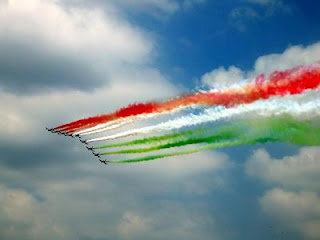
Celebrating the Republic

Sphere: Related Content

Monday 25 January 2010

What Prayer really is

Listening to a prayer by a guest who's come home from Kerala brought back memories. Of listening to my grandma's prayer. She then lived at our ancestral home in a village. Her prayers I remember were more about safety and protection. She asked God to keep her loved ones and their property safe from any harm. To shield them from any evil that could be round the corner. Now this I remember was different from prayers I would listen to, when I was back home in Cochin, a city. People there prayed more about what they wanted, that could better their standard of living. It wasn't about safety. It was either jobs, or better jobs that they asked for. I guess they did that because they knew that better jobs paid more. And more money meant better products and services at home. Bettered standards of living.

What's fascinating about prayers is that, inherently they are designed to seek solutions to felt needs. For my grandma what was an immediate need was better security. Especially since she stayed at an ancestral home that was almost half a mile away from a neighbour's home. She knew this meant she was at the mercy of any mishap like a break in. She needed protection. She asked for the same from God. And God did answer, I guess. I can't remember of a break-in, ever. But for a city dweller the immediate need was a washing machine or a microwave oven. That cost money. And money came from jobs. So that was what was asked for, from God.

Now I think faith's a good thing. But one thing's for sure. Faith or whatever you call it finally translates into our selves seeking solutions to apparent needs. It may be divine intervention that's sought, but what remains as a backdrop to the act is human needs. Its hard for us to resist asking god to fulfill our desires, because we are wired to seek solutions to our biogenic and psychogenic needs.

Now on my part, I think prayer should be more an expression of gratitude to what we have, than a plea for what we don't.

I know, easier said than done.

Sphere: Related Content

Sunday 24 January 2010

What's physical is what attracts

We think Jaden looks mighty cute. That shouldn't be a surprise. After all, we are his parents. But then we witness this phenomenon time and again when we take Jaden out. Perfect strangers are drawn to Jaden. They tousle his hair, or nudge his cheeks, trying to show their affection for him. Why, there was this one time when two girls walked up to us and asked if they could kiss him. He was a baby then. We were taken aback, but decided to let them have their wish. Soon they were on their way grinning broadly. I wonder what Jaden must have felt. I guess he was too young to even know. Nowadays he's more tuned in, but doesn't care too much for people's overtures.


Now I think the simple reason behind the affection strangers show has to do with the physical package that Jaden is. He's mighty cute and he's got a sunshine smile. Those are hard to resist, and so all the affection. But then people have no idea what kind of kid Jaden is. They are instantly drawn to him purely on his physical being. I guess that happens to all of us. The physical is what instantly attracts. What's inside comes later. And what's inside can either reinforce what we feel the first time around, or shatter it beyond repair.

All brands too have a physical part to them. For an FMCG brand that could be the package, its shape and the way its merchandised. For a service brand its the 'physical evidence'. A brand's physical self must appeal for the consumer to make a 'first' move. Of course, what's inside must then deliver. But the first move, that's always on looks.

The most wonderful aspect about Jaden is the fact that he's wonderful beyond his physical self. The attitudes he's picked, and what we think is his intrinsic behavioural self, lift our spirits. So when we celebrate the gift that he is, we do so because of who he is as a little boy. And for that we thank our heavenly father ever day.

We know we will continue with the thanksgiving. Though I think it should be more often.

Sphere: Related Content

Saturday 23 January 2010

Priyanka Chopra is an actress

The joke ain't on Priyanka Chopra winning the best actress award for 2009, the joke's putting her in the company of greats like Mohanlal and Mammooty. And the latter's what the best actress award's done. Bollywood, in fact, has swept the 56th National awards. My take? Bollywood and acting is akin to saying Barack understands what's it like to run a business.

When such asinine announcements are made, its the awards that lose credibility. I know its happened before, and so it was bound to happen again.

But then again fathom the response if this were to happen in the business and consumer world. Imagine if the JD Power surveys put the rickety HM Ambassador in company with Suzuki SX4? Bet JD Power then can kiss itself goodbye. I know the national awards will carry on, asinine acts and all. After all when the government's got to do with something, its never really any good.

Isn't it?

Sphere: Related Content

The Thrill is Gone!


Takin a cue for Drudge's headline, my pick for the weekend is Blues legend B B King's 'Thrill is Gone'.

Note, community organiser turned President of the United States Barack Obama plummets like never before. Rasmussen polls show that 25% of the US. voters Strongly Approve of the way Barack Obama is performing his role as President. Forty-three percent (43%) Strongly Disapprove giving Obama a Presidential Approval Index rating of -18 (see trends).

Also, Obama is seen as anti-business by 77% of U.S. Investors.

The Thrill is Gone!

Oh, and Hail BB King!

Sphere: Related Content

Friday 22 January 2010

The common thread's Consumer Value Creation

It isn't easy teaching two courses at the same time. For me, currently, the two are Business Strategy and Internet Marketing. In fact, to slide from a certain business context in the classroom to another isn't easy. Business Strategy is more firm oriented, whereas Internet Marketing is function oriented. Yet what saves the day for me is the fact that despite different perspectives, the connect between the two contexts can be spotted if I try. Of course, that's what I do and so I see it. For example, the Internet as a revolutionary interface has had a big hand in firms altering their strategies. Tesco for example, uses the Internet to provide for an added retail interface to shoppers who want to shop for groceries via the Internet, when they don't have the time to go to an offline store. So Tesco's retail business model is such that the brick and mortar Tesco store 'complements' its click and mortar sibling.

The common thread across business functions is their orientation towards creating value for the consumer. And so it wouldn't matter if you work in, or study one function or the other. The focus always is on optimising on value delivery to consumers.

For me, teaching multiple courses is delightful to the extent that it opens up varied business contexts that I can access, that illustrate the pursuit of consumer value creation. The study and teaching that I engage in thus becomes a fascinating exercise.

Though I must hasten to add, at the end of the day, I am exhausted. Out of breath, but never out of drive.

Amen to that!

Sphere: Related Content

Thursday 21 January 2010

Overcoming Perceptual Barriers

Mobility barriers are what stop firms moving from one strategic group to another in an industry. The concept of strategic groups and mobility barriers has acute relevance to firms trying to move into newer product categories or businesses within their own industries. Such strategic moves have to be carefully mapped in terms of opportunities that a firm can capitalise on, and internal competencies it can leverage.

But I believe there's an added perspective to such moves. What about the relevance such moves have from a consumer's perspective? Maybe internal competencies and opportunities that exist justify such moves. But will the consumer be as forthcoming? Would there arise perceptual barriers that put a spanner in the works?

I believe so. Let me demonstrate. In India most car majors entered the market either with small cars or sedan category cars. Over time, they moved to other strategic groups within the industry. The small car players graduated into sedan categories and vice-versa. As I mentioned, the added important consideration here is about consumer perceptions that follow such moves. Do consumers look at the car majors that graduate into sedan categories in better light vis-a-vis the ones that move down from sedans into small cars?

Let me first term the consumer driven barrier that encourages or discourages strategic moves as perceptual barriers. Which of the two moves face greater mindset barriers? I believe the 'small to sedan' move encounters greater perceptual barriers as compared to the 'sedan to small' move. That is, perception wise, consumers are more acceptable of sedan-to-small car category moves. A car major that's entered India with a sedan category car and subsequently moves into the small car category faces greater acceptance among consumers. Even to the extent that consumers may be willing to ascribe a premium on such small cars. For example, Toyota entered India with sedan category cars. It now intends to bring in a small car. I believe Toyota's small car will be awaited and then accepted more wholeheartedly. Not so for a major like Hyundai, which currently is extremely popular in the small car category, but has never found acceptance for its sedans. Consumers in India are unwilling to accept Hyundai as a sedan. However, they will continue to extend their patronage in the small car category.

Perceptual barriers, I believe are as critical as mobility barriers when it comes to strategic moves within an industry. Breaking a perceptual barrier is as important as overcoming mobility barriers. Else, a company may come up with a new product, but acceptance wouldn't necessarily be forthcoming.

Which means products, but no buyers. And the blame's not on products, but on perceptions.

Sphere: Related Content

Wednesday 20 January 2010

Wagon Rides in India

'As for you, you return, your bladder unrelieved, to your berth and wonder why an emerging superpower can't have vacuum toilets on its trains, which apparently are running at a profit. You do more. You admire the genius of the Indian State that turns railway travel into a scatological circus. The State as crap-artist .

You are an optimist. You see no reason why trains in India can't be cleaner, why the Common Man-even if he is genetically programmed to prefer a LCD TV to a clean toilet-can't travel like he belonged to a society that can send a rocket to the moon whenever there is money to spare.

You lie there and think, staring in the dark at the berth above, that even as you thought, 1.5 crore people crisscrossing the holy, Vedic land in 900 trains daily are spraying crap at over 100 kilometres per hour across the length and breath of the nation. The nation through which Ganges flows! The nation of pure vegetarian food! And purer ghee! The nation of Brahmins who bathed thrice a day! The nation of perpetual hand washers!

Overhead, the sturdy black beetles of fans whir unstoppably through the pestilential air. You want fresh air. You tug at the glass window. It doesn't open. Ah, never engage with recalcitrance. You give up and look out. There is a full moon rising through the trees like a frisbee. It looks clean, white, beautiful. Another country. And you know for sure the train you are on is not going anywhere near it, no matter how fast it moves.'

- C P Surendran, 'Tale of a wagon tragedy'.

Sphere: Related Content

Its hard to remember, harder to forget

Work at work, and at home is beginning to overwhelm, especially since Alphy isn't well and in bed. The one thing I am guarding against is losing my temper with Jaden as he continues being his naughty self. Don't get me wrong, he isn't the destructive kind at all, yet work pressures sure can get to me.

The other day, a near spank Jaden had to endure left me not happy with myself. I mulled over my behaviour and knew I let the pressure get to me. The sour feeling I had about myself left a lousy taste that lingered overnight. Waking up to find Jaden sleeping like an angel and knowing he had surely forgotten my behaviour provided some solace. It was interesting knowing that he'd forgotten the incident, whereas I found it hard to erase from memory. For his age, it hadn't affected him, for mine, it left a sour feeling that was hard to wipe away.

In the consumer world too, most incidents or engagements will be forgotten. I forgot what happened at my retail store last month. I have a foggy memory of having shopped there, though I can't remember the details. Yet amongst this forgetful normalcy, some consumer engagements will be remembered. The delightful and the nasty ones. A delighted customer will remember enough to be back. The hurt one's gone forever. Now as much as possible, marketers must ensure customer encounters are made memorable. So they remember. So they come back.

Moreover what's fascinating is the fact that as much as its hard to remember, its harder to forget. And in the latter lies a marketing opportunity.

Of a lifetime. And its called Customer Life Time Value.

Sphere: Related Content

Monday 18 January 2010

What's not ordinary is what gets you talking

The weekend saw me take an official trip to Lucknow. Returned late last night. The flight into Lucknow was a pleasant but a long one. The trip started from Bangalore, on to Calcutta, then to Patna and finally to Lucknow. Whew! Now I must say Indigo does a great job with its flights. Decent flying and smart service on board.

And then there was this interesting incident on board. From Patna to Lucknow we had the former Railway Minister, also the former Chief Minister of Bihar as a co-passenger, sitting in the row beside us. Now it was my first time seeing Laluji and he turned out to be just the way he is on TV. He smiled at us and I guess we felt grand. Since returning back from Lucknow I must have narrated this incident to a quite a few people I came in contact with. The reason's pretty simple. After all, its not everyday you have Lalooji as a travelling companion, that too plonked on a seat beside you.

The Marketing angle to this whole incident is interesting too. Indigo did a great job in flying. Maybe the next time I scout for tickets, Indigo will be on my radar. But what got me talking was an incident on board, that was out of the ordinary. This incident loosens my tongue and I so go about repeating the story to people I know.

Brands must know that great performance may instigate loyalty. But then they must also know its what happens out the ordinary that gets the customer talking. About the brand or about its place in a story, to others. Such talk is what spreads the word about the brand to other possible customers. On my part, I mention Indigo because Laloo as on board. My narration of the story features Indigo, as an airline that did a great job at flying. This talk of mine paints a possibility of my loyalty, but more importantly, opens up an opportunity for the airline in terms of possible new customers. Because you read my story and maybe next time you consider Indigo as your airline of choice.

Sphere: Related Content

Thursday 14 January 2010

Survival matters, in Haiti

At times, brands don't matter. In fact, nothing does, except survival.

Praying for Haiti.

Sphere: Related Content

Sharon's Catherine Tramell vs. Meryl's Joanna Kramer

You could say its because I am besotted by her, but I recommend you don't 'cos she has an IQ of 154. The tabloid press may have reported her remark as being a backhanded compliment, but I recommend you not be be swayed, and instead analyse it for the 'marketing logic' it carries.

This is what Sharon Stone said about Oscar winning actress, Meryl Streep, "I think that's why Meryl Streep is working so much, because she looks like a woman we can all relate to. I look at her and I think, I'm chasing my kids, I've moved my parents in with me, I'm coping with food spills - that looks like me in real life. Meryl looks like an unmade bed, and that's what I look like. To me, that looks true."

Sharon in saying what she said, has demonstrated the difference between what's termed 'Identification' and 'Aspiration'. We identify with what we are and aspire (read, desire) to be what we aren't. Meryl's who women viewers identify with, and Sharon's who they aspire (desire) to be.

Why Meryl's plenty on screen is because its the 'mass consumer effect'. Hordes of women, from middle and lower part of the class divide see her as embodying their lives. So they take to her, big time. Her movies are the kind they watch, thus, in effect giving her even more opportunities for roles on the silver screen.

Sharon's a contrast to Meryl. If not many, there surely must be women who desire to be Catherine Tramell. Maybe not literally. But at least that's the fantasy. Sharon plays such fantasy parts to perfection. With smoking hot looks and an attitude to match, Sharon's the one who can effortlessly get women to want to be in bed with a hidden icepick. The only hitch is, the Catherine Tramells can't come in mass consumer proportions. The opportunity on the sliver screen for such characters is limited, and therefore Sharon has to wait, while Meryl's continuously on song.

The marketing lesson in Sharon's comment is noteworthy. That if its identification that you can employ, it'll be mass consumer proportions that you get. If its aspirations that are being built, niche is what you can expect.

Pic: Wikipedia

Sphere: Related Content

Tuesday 12 January 2010

Why Car searches begin online

Despite low Internet penetration level, according to a Google study, every third car buyer in India’s top cities start their search on the world-wide web. Four out of every ten new car buyers and three in every ten used car buyers use the Internet to do their initial research before making the purchase.

Let's figure why.

The reason why the Indian car buyer's (for that matter, any car buyer) online is twofold. One, their product involvement is high due to the purchase risk involved. This risk may be financial or even social, and so consumers actively seek external information about various available car brands. The information thus gathered helps them spot the right car brand, better. Two, the genesis to this search is the Internet simply due to the convenience it offers the searcher. The consumer doesn't have to move a muscle to access information about car brands, online. But whats important to note is that this search may only contribute the formation of the consumer's primary consideration set. Further evaluation of the brands in the set may require the consumer seek relevant reference groups. It may even result in a visit to the considered cars' showroom for a talk with the dealer and a test drive.

High product involvement means the information search by the consumer is active, external and widespread. The Internet is where such searches start, but surely not where they end. Curtailing the search would require the consumer go beyond confines of Internet into the real world.

'Cos that's where there's more information. And of course, the cars.

Sphere: Related Content

The herd in Avatar viewers

People experiencing depressive or suicidal thoughts after viewing Avatar has more to do with Friedrich Nietzsche's Herd Mentality than anything else. Note, the exhibition of such thought has overflown on Avatar forums. More than a thousand posts have appeared following a thread titled, "Ways to cope with the depression of the dream of Pandora being intangible".

Nietzsche's 'Herd Mentality' categorised people as belonging to two herds. One consists of people who subscribe to religious points of views and the beliefs therein. These in turn dictate their actions. The other, The 'Avatar-depressed kind', lend themselves to be influenced by media. Media communiques set the basis for what they perceive as right and wrong.

Avatar and its message has preyed on the people belonging to the latter heard, convincing them that human race will be responsible for the destruction of whatever is 'natural', in the future. The herd, buying into this story, huddles together to wail, as seen in the threads on the forum. I don't think we need to be unduly worried, as I guess they'll wise up pretty soon.

And then, we have Oliver Stone and Hitler to look forward to. When that happens, there's real material there, to be depressed.

Sphere: Related Content

China in the Auto seat

China's now supplanted the U.S. as the world’s largest auto market after its 2009 vehicle sales jumped 46 percent. Goes to show how economic growth averaging nine percent's behind greater consumer and industrial buys.

Sphere: Related Content

Monday 11 January 2010

Perceptual Blocking on a Bus ride

The most stressful a bus ride gets for me is when there's a psycho driving and I sitting up front, am witness to his insane manoeuvres on the road. I try my best not be hassled by the bus' swerving and weaving. But I tell you, at times your body involuntarily flinches as the bus gets too close to another vehicle. The best way to manage this stress, I found, is to close your eyes and let your ears tune into music from an MP3 player.

This 'defense act' of mine comes close to being termed as perceptual blocking. Note, mine is a conscious act. Perceptual Blocking is about consumers protecting themselves from being bombarded with stimuli by simply "tuning out", blocking such stimuli from conscious awareness. They do so out of self protection because of the visually overwhelming nature of the world they live in.

Perceptual blocking is one reason why marketers need to careful using, for example, fear appeal as content in their communiques. Push the fear too hard, and consumers will block out the 'fear-instilled' stimuli. That is, if the image in the advert is too macabre, then rather than shocking people into compliance, it would only have them shielding their eyes from what's featured.

Perceptual blocking is our way of ensuring that we aren't overwhelmed by all the stimuli around us. Stimuli that our senses can respond to. Its what helps us maintain a sense of balance in an otherwise uneasy world of stimuli overload.

Its also my way of ensuring I have a stress free ride on a bus.

Sphere: Related Content

Sunday 10 January 2010

The experience of Natural User Interface

'But I believe we will look back on 2010 as the year we expanded beyond the mouse and keyboard and started incorporating more natural forms of interaction such as touch, speech, gestures, handwriting, and vision -- what computer scientists call the "NUI" or natural user interface. This process is already well underway through the proliferation of new touch screen phones and PCs, and in our growing reliance on voice-controlled in-car technology for communications, navigation, and entertainment...

While Project Natal will transform the video gaming and in-home entertainment experience, I believe it only hints at the potential of the technology behind it. In the near future, computers will do more than work at our command: they will work on our behalf, acting as assistants that understand what we want and possessing the intelligence to carry out complex tasks in a way that accurately reflects -- and even predicts -- our preferences and intentions.

Simply put, NUI is about easing discovery so that the computing technology that surrounds you acts as a more natural and dynamic partner, not a tool, for helping you work, live and have fun. And, I believe these advances will help usher in a new generation of human-computer interaction this decade.'

- Steve Ballmer, 'CES 2010: A Transforming Trend -- The Natural User Interface'.

Sphere: Related Content

Saturday 9 January 2010

By George, Consumer Hell or Happiness?

'This is the consumer society taken to its logical extreme: the Earth itself becomes disposable. This idea appears to be more acceptable in some circles than any restraint on pointless spending. That we might hop, like the aliens in Independence Day, from one planet to another, consuming their resources then moving on, is considered by these people a more realistic and desirable prospect than changing the way in which we measure wealth.

So how do we break this system? How do we pursue happiness and well-being rather than growth? I came back from the climate talks Copenhagen depressed for several reasons, but above all because, listening to the discussions at the citizens’ summit, it struck me that we no longer have movements; we have thousands of people each clamouring to have their own visions adopted. We might come together for occasional rallies and marches, but as soon as we start discussing alternatives, solidarity is shattered by possessive individualism. Consumerism has changed all of us. Our challenge is now to fight a system we have internalised.'

Oh, I think I get it, George. We replace a consumerist society with one that pursues happiness and well being, not growth. But pray, how do I get to happiness and well being? Oh, it dawns on me. I meditate, mull over my cosmic being and go back to being a caveman. That should do me and the rest of the world a whole lot of good. But then, I decide not to. I'll tell you why. Because while I am ready to go back to chomping on carrots and sitting cross legged, I am not sure if the ones who preach the cross-legged carrot solution are themselves doing what I do. Plus the solution's bogus. We should know it by now.

I'll let James Lewis illustrate what I've said.

'BBC’s climate doom correspondent Paul Hudson asked plaintively a few months ago: “What happened to global warming?” Wrote Mr. Hudson:

'This headline may come as a bit of a surprise, so too might the fact that the warmest year recorded globally was not in 2008 or 2007, but in 1998. But it is true. For the last 11 years we have not observed any increase in global temperatures.'


Here’s a guy who built a glittering career on global warming fraud. That BBC headline should have collapsed the whole fraud right there and then. After all, the Bolshie Beeb has been leading this charge for decades. Paul Hudson’s public confession is like Gorbachev finally ‘fessing up that Marx, Lenin, Stalin, Mao, Fidel, Kim, Pol Pot (and Obama) had it completely wrong after all. All those 100,000,0000 dead people and nothing to show for it. The Beeb’s Orwellian Ministry of Truth has been pushing global warming every single hour of the day for lo these many years. Now the New York Times actually had to go out and find an honest man to break the news to its readers (John Tierney). Its global frauding correspondent, Andrew Revkin, has resigned and fled the scene of the crime.

Scientists used to be poor but honest, but that was when they slept in garrets and dressed in grungy sweaters. Today they have glittering dollar signs where their eyeballs used to be, like a Vegas slot machine, and their magic number has 13 zeroes: ten trillion dollars for climate fraud. That’s an official estimate from the “Stern Review,” authored by distinguished British fraudocrat Lord Nicholas Stern in 2006. The same number also comes from the skeptical side, from the Marshall Institute, which has done careful economic projections about the cost of “global warming” abatement.

That’ll be ten trillion dollars, please. Cha-ching! Shall I wrap up that planet or do you want to eat it here? Ten trillion buckarooneys is why all those green fraudsters jetted into Copenhagen, and that’s why they kept going for a while even after Climategate ripped open their fraud for all the world to see.'

Coming back to the consumer hell George Monbiot was talking about, let's see it for what it really is. Let me illustrate. Guess George likes his croissants every morning. Biting into a warm flavourful croissant must surely give George his moments of morning delight. But what George fails to see is what's happened in the background, that has him, or for that matter any of us, savouring these palate pleasures. Note, the croissant must have been made from the finest of wheat. To grow such fine wheat, someone needed to make a machine that could till the fields, reap the crop, thresh it and then get it into a powder form. Making those machines would surely have required someone to mine an ore and turn it into material that then becomes part of the machine. The powdered flour that becomes dough, that turns into a baked croissant, again have machines to thank. I could go and on. But I guess, what I want to say is crystal clear.

Also, I hope this too comes across loud and clear. Industrial activity is a result of man's ingenuity. It takes people to come together in value creating tasks for industrial activity to flourish. Such activity mustn't be frowned upon. For it is what's truly noble. This very act is what's at the heart of human prosperity. At the heart of human happiness and well being. Of course, natural resources will be used in such activity. And they must. After all the earth is a gift from the Almighty to mankind. Again, not all industrial acts result in win-win outcomes. Some do have their ill-effects. But tell you what, as we progress, we will only see the act get better. That means resources will be utilised better, and more efficiently. Plus used resources will be replenished better.

If you don't believe me, then you don't believe in the power of human ingenuity. That, trust me, is more worrisome.

Sphere: Related Content

"Forever and Ever Amen"

Sphere: Related Content

Friday 8 January 2010

Passive Learning & Recall Triggers

Its interesting that despite there being close to fifty songs on my MP3 player, every time I play them, I know the sequence in which they will run. I mean, as I listen to one, I know what's the next one, and the next, and so on.

Now I've never actively tried to learn the sequence. What's happened is, my memory passively picked the sequence as I played the songs over and over again. The sequence set into my memory through repetition. This sort of learning is termed Passive Learning. What's important to note is the fact that, should I try and remember the sequence when I'm not plugged on to the player, I can't. The sequence comes to me only when I listen to the songs.

Most mass media communication used by brands facilitate passive learning. Should you ask consumers to retrieve and recall such passively learned material, in all probability they won't be able to. But what saves the brand and makes it part of the consumer's consideration set is an encounter with it at the store. Because its merchandised well.

For low involvement category brands to make it to a consumer's consideration set, passive learning must work in conjunction with great merchandising that acts as a recall trigger. One without other isn't good for brand. For it may result in either the consumer not recognising the brand on a shelf and therefore not considering it, or not encountering it on the shelf and therefore despite the possibility of recognition, failing to feature it in his consideration set.

Sphere: Related Content

Thursday 7 January 2010

3 to a Nation of Idiots

'Yet I found Three Idiots far too preachy, far too sanctimonious and far too much of a caricature. It lampoons and trivializes our higher education system as an unrelieved arena of bad teachers, suicidally pressurized students, manic success-oriented parents and evil money seekers who care nothing for learning but only want grades so they can get big jobs and Lamborghinis. Such a caricature is, as we all know, far from the truth. Although a liberal arts degree doesn't compare to an engineering degree, my own experience of higher education at St Stephen's College and Oxford University, is that it is an immensely enriching experience, consisting of many idealistic teachers and the excitement of new ideas is something for which there is no substitute.

Yet a film whose central message is "the education system sucks", "we learn nothing at our centres of excellence" and "teachers are unable to teach and only want to ruin students lives," is a rather dangerous film. Three Idiots disdains the rigour of study, pours scorn on wanting to better oneself through the sadhna of learning and instead seems to suggest that to be happy in life we all need to drop out, sing songs under the night sky and not bother with studying hard because studying hard is a waste of time. As a former IITian has pointed out Rancho, in the film mocks Laplace Transform, the equation written on the blackboard, as an example of rote learning. Yet without Laplace Transform, Hirani's computer would not boot up! This former IITian says he has never come across a teacher like Prof Virus, and believes that in its fashionable disdain for education, the film is dangerously juvenile.'

- Sagarika Ghose, 'From Three Idiots to a Nation Of Idiots'. (HT: Ashutosh)

Sphere: Related Content

Aamir needs Branding lessons

If the Chetan-Aamir feud's an engineered one, the biggest loser will be Aamir. To know why, you first need to know what Brand Personality is. Brand Personality is a set of human characteristics that become associated with a brand.

Aamir's quite the Bollywood brand. Some one's who's crafted his image carefully. He's tried to build himself up as the thinking, honest, sincere actor. That's the personality he's carefully crafted for himself. Sample his blog post;

'Have been going through your responses post the CB controversy. Some sincere and some insincere. The insincere ones I choose to ignore, but I am very keen to respond to those of you have had very sincere queries, questions and even assumptions. I am very keen to present my side of the story, why I said what, why I feel what I feel, and what is the difference between a book and a screenplay, what I feel about ethics of this issue, fair play, morality etc. The whole gamut. I would also like to present some very interesting evidence.

However I would not like to do this right now.

The reason is, that first of all, I think that it is very important that we distance ourselves from this incident to be unemotional about it, me included. Only then will we be able to examine the merits of the case in an unbiased and clinical manner. I am a very emotional person and find it very difficult to be clinical, so for me distance is most important.'

J. L. Aaker in his work, 'Dimensions of Brand Personality' (Journal of Marketing Research), identifies five basic dimensions on which consumers base brand Personality. They are, Sincerity, Excitement, Competence, Sophistication and Ruggedness. The dimensions that apply most to Aamir the brand, is 'sincerity' and 'competence'. Sincerity as a dimension in turn is a make-up of facets such as, Down-to-earth, Honest, Wholesome and Cheerful. Competence is driven by Reliability, Intelligence and Success. Aamir the brand will suffer on one of the two mentioned dimensions, should it be known that the feud was a hoax. Aamir then may no longer come across as 'Sincere.' On competence, he may continue to score. But sincerity will take a beating. The Personality he's carefully crafted may crumble.

Of course, even if the hoax is true there's no way to find out, unless one of the parties coughs it out (almost impossible, I must say). And even if one party sings like a canary, the other can play the denial card.

Its evident from the way Aamir's singing on his blog, he doesn't want any semblance of the hoax story to stick to him. 'Another reason is that I would not like any more undue publicity for or against anyone. A few responses have expressed that maybe this is a controversy that we have cooked up to get publicity for the film. This stance of mine should satisfy them too.'

I bet Aamir has had takeaways from this controversy. In the coming times, he's bound to shut up more often, than go yakety-yak. If he persists with the yakety-yak, I'd recommend he takes a lesson in Marketing, maybe two in Consumer Behaviour.

Sphere: Related Content

Wednesday 6 January 2010

Who's the real Idiot?

Nikhil's question got me thinking. It had to do with the movie, 'Three Idiots'. He wanted to know if all the bad blood that the Chetan Bhagat-Aamir/Hirani/Chopra feud had generated was publicity good enough to help sales. For the book and the movie. The answer is a resounding Yes. Nikhil's follow up question then was if publicity on its own was good enough a tool in generating awareness for any brand. My answer's a Yes and a No. Publicity, if carried by almost all media houses can generate maximum awareness. But if its limited in its 'carriage' (read, picked only by few media houses) then its reach may be curtailed, therefore limited. This would then require that mass media vehicles be used and Ads run so as to generate greater reach.

But where publicity scores over advertising is in its effectiveness. The consumer's engagement with a media story (read, publicity) is an active one. The Chetan-Aamir controversy has generated enough heat to have eyeballs glue to news screens on TV and print stories in newspapers. This is in contrast to mass media advertising. The consumer's engagement here is passive. And so the communique lacks the ability to generate 'active' interest. In other words, in all probability our eyeballs ignore the commercial on TV or the print Ad in a newspaper.

The subsequent implication is, the 'recall power' generated through publicity is far greater than what's garnered through mass media advertising. That in turn means that publicity has greater chance of ensuring that the brand in question features in a consumer's consideration set.

Here's something to note. If some reports are to be believed, the Chetan-Aamir feud was an engineered one. If that were so, the real idiots include the one writing this post. :)

Sphere: Related Content

Tuesday 5 January 2010

The Believer & The Skeptic

It seems the US. winter of 2009-1o could turn out to be their worst in twenty five years. What bad timing, for the warmists! The winter had to come at a time when the world was beginning to doubt global warming. And more so since it was just a li'l while ago that we had Climategate.

Will the winter drive a nail into the Global Warming coffin? I doubt it. Yet what it may do is increase the number of doubters, thus putting a spoke in the wheels of the green-industrial complex.

About time.

Brands too face a certain amount (maybe even large doses) of skepticism when they come up with claims. Can a fairness cream truly get you a job? It may get you a mate in India. But a job? I am sure there are those who believe there's a direct correlation between the colour of your skin and your job prospects. As to whether its a majority or just a minority can be ascertained by whether the brand's flying off shelves.

In India, fairness creams are being lapped up left, right and center. Guess that means there is a correlation between skin colour and job prospects. Or maybe it means majority belief is almost always wrong.

My vote's on the latter.

Sphere: Related Content

Morality & India

Partha Sinha's articles, according to me are a must-read, though I may not always agree to his point of view. His perspectives are downright insightful.

Sample this one on 'Ethical Branding' in India. I for one agree, totally.

'In India, the sense of right and wrong is a more fundamental discourse than anything else. We can ignore information, we can ignore observation we can even ignore objectivity. But we mostly succumb to the social code of morality and try to justify every action from that point of view. The concept of morality always has an undertone of either religion or politics. Indian society is fundamentally governed by an overdose of religion and politics and, hence, morality is always the default force. Some scholars argue that in Hinduism morality and law is often one and the same and can be used interchangeably. I think this viewpoint is the source code for our misplaced sense of morality...

The biggest advantage of Indian morality is that it’s mostly symbolic. Without doing anything meaningful or acting responsible in any manner, a brand can create a token sense of morality. Be it reminding people of their filial responsibilities, or allegedly taking sided with darker women or even representing the interest of the less fortunate. And more often than not this morality is disseminated only through advertising. So far we were used to ‘claim level’ ingredients in our product – the next thing brands will use to differentiate themselves would be a ‘claim level’ morality.

Ethical branding in India is a far cry. What we are likely to witness a lot in the near future is that brands trying to exploit our misplaced sense of morality to create a symbolic high ground.'

Sphere: Related Content

Sunday 3 January 2010

Navigating a Cultural Maze

Navigating consumer markets in developing countries is like walking the hot tin roof. One false move and you're in soup. The key to getting the walk right is knowing to respond to 'cost' and 'localisation' pressures. Pressures exerted on business models when they operate outside of their parent location (read, in global markets). The former, I feel is far easier than the latter.

Especially if the market in question is India. Its far easier to craft a low cost business model to take on the mass consumer than it is to localise as per regional requirements in India. That's because the diversity is so overwhelming its easy to slip up while operating in a particular region. The variables that contribute to this overwhelming diversity are cultural, sub cultural, religious and linguistic in nature. What's important to note for marketers is that these factors of diversity go to the core of an Indian's identity. Mess up with them, and an Indian will perceive it as an attack on his identity, and so in all probability will retaliate. The retaliation will be justified as it will be seen as an issue of a very identity being challenged, being called into question.

Its no wonder than Google is trying to balance the 'freedom to express' and 'the need to curtail' act, in a cultural hotbed like India. As much as Google allows for free expressions, in India its wizened up and moved to curtail what may be deemed as offensive to cultural and regional sensibilities.

Note WSJ's story on Google in India, 'The incident shows the treacherous terrain Google must navigate as it expands in India, the world's most-populous nation after China and a major growth market for Web searches, online advertising and mobile phone software. As Google broadens its reach, it must increasingly tweak the way it operates to suit new cultures. While authoritarian countries pose well-known challenges, Google is learning that even democracies such as India can be fraught with legal and cultural complications. Its experience here could serve as a precedent for other Web companies.

The nation of 1.2 billion is the world's largest democracy and in principle affords free speech to its citizens. But the country has a volatile mix of religious, ethnic and caste politics and a history of mob violence. So, the government has the authority to curtail speech rights in certain cases. India's Constitution encapsulates that gray zone: Free speech is subject to "reasonable restrictions" for such purposes as maintaining "public order, decency or morality."

For business models to work in India responding to localisation pressures is an imperative. The only time when this may not be required is when the cultural variables that differentiate, ease up or even vanish. Will that happen? Surely it will, though it may take a decade or two. Increasingly its being seen, especially in the metros, that newer generations take lesser to an inherited cultural identity, in comparison to its predecessor. The transition of deriving identity from culture to deriving it from what's globally practiced and accepted may happen over the coming decades.

And when that happens, Business models may not have to respond as much to localisation pressures as to the pressures to go one up on competitors who will come from all corners of the globe. The battle for the consumers in such times will be fought more on how brands differentiate via innovation than on how they align themselves to cultural sensibilities.

Sphere: Related Content

Saturday 2 January 2010

Carbondioxide & Climategate

'Most of the carbon dioxide emitted by human activity does not remain in the atmosphere, but is instead absorbed by the oceans and terrestrial ecosystems. In fact, only about 45 percent of emitted carbon dioxide stays in the atmosphere...

Many climate models also assume that the airborne fraction will increase. Because understanding of the airborne fraction of carbon dioxide is important for predicting future climate change, it is essential to have accurate knowledge of whether that fraction is changing or will change as emissions increase.

To assess whether the airborne fraction is indeed increasing, Wolfgang Knorr of the Department of Earth Sciences at the University of Bristol reanalyzed available atmospheric carbon dioxide and emissions data since 1850 and considers the uncertainties in the data. In contradiction to some recent studies, he finds that the airborne fraction of carbon dioxide has not increased either during the past 150 years or during the most recent five decades.

- ScienceDaily (The research is published in Geophysical Research Letters.)

Sphere: Related Content

The pride in Solutions for Masses

What the Chotukool and Swach represent is as important as what they are.

Chotukool is Godrej and Boyce's breakthrough nano refrigerator. The ChotuKool is like no other fridge. It does not have a compressor. It runs on a battery. Utensils and bottles need to be loaded into this 43-litre cool box from the top. It weighs only 7.8 kg and costs only Rs 3,200. And, of course, it is Candy Red in colour.

Swach is the Tata Group's water purifier priced for the masses. The Tata Swach – Hindi for “clean” – meets U.S. Environmental Protection Agency standards, and doesn't require running water, electricity, or boiling. Tata's water filter grew out of a decade of research and development. It uses paddy husk ash as a matrix, bound with microscopic particles of silver to kill the bacteria that cause 80 per cent of waterborne disease. Tata Swach is cheaper than boiling water, cheaper than bottled water, and 2.5 times less expensive than Hindustan Unilever's low-cost Pureit filter. Tata will sell two versions of the 19-litre Swach container, priced at 749 rupees ($16.11) and 999 rupees ($21.48), depending on the material. The filter itself costs 299 rupees ($6.43). It will purify 800 gallons (3,000 liters) of water – enough for a family of five for a year – before it automatically shuts down.

These products are ones to be proud of. Because they take solutions to a set of people who are otherwise untouched by innovation and its fallouts (read, products and services). What the Chotukool and Swach represent is the ingenuity of private enterprises that consider masses a viable consumer segment. Viable in terms of developing innovative solutions based on a cost-driven business model, while guaranteeing profitability. Its also important to note that these innovations sprout sans any governmental help or interference. Goes to show why the best bet to rural development lies squarely on the shoulders of private enterprises that must be allowed to flourish in a manner unfettered.

Therefore its time we in India rethink our dependence on government. And design systems that allow for more private entrepreneurship to flourish. I can bet they will, and in the process create the kind of solutions that Chotukool and Swach are, so long as private, free (thank god for Indian democracy) individuals are allowed to tap into their own ingenuity.

Sphere: Related Content

You And You Alone

Sphere: Related Content

Friday 1 January 2010

Life imitates Art!

Just as I thought Day One was going down quiet, a news conference pops up on screen where a producer plays the exact part that protagonists in his movie play. That of idiots.

Ask me why. Because he almost went berserk during a news conference and asked the media people to shut up. Ask me why. Because they asked him whether his movie was based on the book written by Chetan Bhagat.

As for Vidhu Vinod Chopra's behaviour I must give him credit for playing out the title part of his movie to the hilt. His behaviour goes to reinforce what I've always believed about Bollywood, the nincompoopiest movie industry in the world. I label the producer what the title states, because despite being some hot shot guy at Bollywood, he forgot the simple rules of any engagement,

that its better to shut up and show the world you are an idiot than to open it and remove all doubt,

that its better to shut up and let controversies die a natural death than to go berserk and set it on fire,

that when you are seen as an established group of biggies, it isn't wise to take on a single person because that would then give rise to a Goliath vs. David perception in the minds of viewers. And you know in a Goliath vs. David battle where the common man's sympathies lie. The Blogosphere tomorrow, and beyond will demonstrate what I am talking about.

The best response for Aamir and gang was to lay low and not go public with their ranting and whining. It makes them all look like you know what. Now the other two actors in the movie, I must add, played dumb to perfection during the press conference. After all they too had to play their parts. That's why it wasn't without reason that the movie was titled what it was.

'Three Idiots'!

I say, add more numbers to that!

Sphere: Related Content

Happy New Year!

Sphere: Related Content