Thursday 30 April 2009

Obama's 100 days into Serfdom

'In The Road to Serfdom, Nobel Laureate Friedrich Hayek explained that socialism and fascism are really a common system based on the belief that central planning is superior to individual liberty and market capitalism. So it matters little whether the Obama administration is moving us towards socialism or fascism. It certainly is moving us away from market capitalism and limited government and towards central planning.

Truly disconcerting is that within 100 days of the Obama administration Newsweek had a cover story entitled, “We Are All Socialists Now,” and a recent Rasmussen national telephone survey found that only 53% of American adults believe capitalism is a better system than socialism.

Mises’s warnings about the 1930s need to be headed today. While many economists are concerned about the massive federal deficits and expansion of the money supply of the first 100 days, the real threat to the economy comes from the philosophy that has been expounded by the administration and the ranking majority in Congress -- that left to our own actions we will create financial ruin, destroy the planet, and be left without health care.

Their solution is to allow central planners of an unlimited government to guide our actions. This is the real threat to our liberty and our prosperity.'

- Gary Wolfram, '100 Days of Obamanomics'.

Sphere: Related Content

Be afraid, be very afraid.

When President Obama says 'he's remaking America', I say, 'Be afraid, be very afraid.'

Sphere: Related Content

Loyalty's about people engagement

As the class of 2007-09 leaves Alliance, it would interesting to mull on the strength of their future affiliation with the institution. My gut feel tells me it will all depend on how they take the engagements they've had with various personnel, including faculty. If its been a memorable one, they will seek and stay affiliated.

Its the same scenario when it comes to retail houses. Affiliations to such places of trade for the consumer will be dictated by issues beyond products on shelves. It will all depend on people engagement they have had at retail stores. I mean with the floor personnel there. If its been a good one, and hopefully the shelves haven't disappointed, the consumer is bound to be back. Else he parks his business elsewhere.

In an era where commoditisation of brands (read retail houses) is a taken, its the people on the shop floor that can bail a retail house out. They are the ones to bank on, to get the consumer back. Just as, its always the faculty and how they have had interactions with students that would make an institution memorable.

Here's to the class of 2007-09. It was brilliant having you here. Ciao and Cheers. :)

Sphere: Related Content

Wednesday 29 April 2009

Know CK Janu? Why am I not surprised?

'The pitch was made, the client loved it. The agency got to the business of getting the advertising platform right. It looked at tea and its immediate associations — revolution, people, young people sitting at corner tea shops and tea houses, discussions, change in-thinking and so on. It took these ideas and ran with the line ‘bus uthaata nahi, jagaata hai’...

Soon enough the ‘Mr politician, what are your qualifications?’ commercial was made. Tata Tea definitely needed something of that stature...'

One thing's certain about this campaign that gets me irritated no end. Its perfect for the Indian Jaago Re youth. Though the irony is tea and revolution isn't something they'd ever understand. Because if they did they would be smarter than to ask for 'qualifications' before they decide who to vote for.

Don't get it? Why am I not surprised? Ever heard of CK Janu? She is the kind of stuff, 'Tea & Revolution' is made of. Just so the dimwits know who she is, let me quote from Wikipedia.

C. K. Janu is the leader of the Adivasi Gothra Maha Sabha, a social movement that has been pushing for land to be redistributed to landless adivasis and that grew out of the Dalit-Adivasi Action Council.

Janu's background is Adiya, one of the adivasi groups in Kerala who used to be indentured laborers (adiya actually means slave) and whose people are still mostly landless agricultural laborers. Janu had no formal education but learned to read and write through a literacy campaign that was conducted in Wayanad, the area in the north of Kerala, near the border with Karnataka and Tamil Nadu, where Janu comes from. Her biography is quite typical of Adiya people: she used to be landless (until she organized a long drawn-out struggle to occupy land with her community and finally got a piece of land) and used to work as an agricultural laborer. Actually, as she never gained much money with her political career--or even lost money on having to pay for her political activities--she still often does this kind of work to get by.

Going by the Jaago Re campaign, I don't think the youth are going to vote for the likes of CK Janu. After all, she has her qualifications steeped in the literacy campaign run in Kerala. That may not be enough for the Jaago Re youth. But then the Adivasis don't care. To them, CK Janu is a leader.

Tell you what. That's what counts.

Sphere: Related Content

Tuesday 28 April 2009

Reality Stars & Mirror effects

I have talked about this before. Most youth reality shows (count the musical ones out) in India center around an exhibition of foul mouthed crass behaviour. I guess these shows have their huge following in India.

That's such a pity.

More so in the context of what Dr. Drew Pinsky states in his latest book, The Mirror Effect: How Celebrity Narcissism is Seducing America. The book deals with narcissistic levels of American celebrities and the impact it has on impressionable teenagers.

Note Christian Toto; 'Today’s narcissistic celebrities shove their neuroses in our faces. Take Amy Winehouse, the troubled torch singer who inspired a slew of drug-related headlines. Her song “Rehab” was a narcissist’s cry of defiance, according to the book, and a troubling one when teens started singing along without realizing what her statement truly implied.'

Celebrities are part of what's known as reference groups, that have the power to influence behaviour. Today's reality show participants too I believe have taken on overnight celebrity mantles. That they exhibit behaviour that's downright pathetic wouldn't matter to the 'young uns' watching. What's troubling is, there's always a possibility of the 'mirror effect' hitting home. What makes the effect even more potent is if the watcher has had to weather childhood trauma.

Note again; 'Some of the book’s material is alarming, to put it mildly. Childhood trauma, Pinsky writes, makes people vulnerable to “unhealthy levels of narcissistic traits.” And incidences of childhood trauma have increased by more than 40 percent over the past 20 years. The most jarring information involves how teenagers evolve as social beings. Their emotional development stalls in their teens, leaving them susceptible to the flood of narcissistic content heading their way.'

Sphere: Related Content

Gold's lost its glitter

WSJ: Indian jewelers' hopes that the Hindu holy day Akshaya Trithya would give a fillip to declining gold sales look to have been dashed, as many customers stayed away or scaled down purchases. India is the world's biggest gold buyer, but imports have fallen to negligible levels in recent months as the rupee has weakened, making dollar-denominated gold more expensive to local buyers. Akshaya Trithya, which fell on Monday this year, is considered an auspicious day to make long-term purchases or start new ventures - Akshaya means "the never diminishing" in Sanskrit - and has traditionally boosted gold demand in India. Gold sales usually pick up the week before the festival.

At around 14,800 rupees ($293) per 10 grams, retail gold prices were about 25% higher this year compared to prices at last year's festival, levels unattractive to India's famously price-sensitive gold buyers. That increase is due to a weaker rupee - gold is denominated in dollars internationally - which at last year's festival was around 40 to the dollar against about 50 to the dollar this year.

Sphere: Related Content

Blind to the duration effect?

I just had the 'duration effect' hit me big time. I go to the breakfast counter and find that the dosas for the day have gotten over and that fresh ones are to arrive. So I wait. And it seems like an eternity. Though its been just a minute.

That's the point I want to make. What is just a minute may seem like an eternity to the consumer. That is, to the consumer who's waiting. It would be foolhardy on the part of the service provider to ever point out that its been just a minute. Because that minute seems like forever for someone in a queue.

Most service providers don't get this. They think, what's the big deal? After all, its been just a minute. Remember, the consumer in the queue, at a store, on the telephone, wherever, is losing his temper by the second. Speed up and try and make the wait a pleasurable one. Else you will have an irate customer on your hands. And you being blind to the duration effect, wouldn't even know why.

Pity.

P.S. - I wished I had waited for bacon n' eggs. Hey, its a wish. :)

Sphere: Related Content

Monday 27 April 2009

Why does the middle class matter?

'More importantly, while the middle class forms just 11.4% in 2007-08 of the total Indian households its share of total income is nearly one-fourth and saves more than 55% of its income. The growing clout of the middle class becomes even more apparent when one looks at the ownership patterns of household goods. Nearly 49% of all cars are owned by the middle class, compared to just 7% by the rich. Similarly, 53% of all airconditioners are owned by middle class homes. Nearly 46% of all credit cards are to be found in middle class households.

What’s more, the Indian middle class is far from being a homogenous group. While more than half the urban middle class households are salary/wage earners, the biggest proportion of rural households are self-employed in the agricultural sector. Patterns of product ownership also show a divergence when it comes to rural and urban middle class households.

While only 24% of rural middle class homes own a car, more than 40% do so in urban India. Televisions too are to be found in 90% of all urban middle class homes compared to 62% in rural middle class homes. Though this is an opportunity for marketers, it’s clear that addressing the middle class with a one-size-fits-all mindset is unlikely to work.'

- Rajesh Shukla, 'Why does the middle class matter?'

Sphere: Related Content

The rich aren't getting richer, that's bad

At least now you can say, the rich aren't getting richer.

At least now you can say, the rich aren't getting richer. Britain's richest people lost 155 billion pounds in the past year because of a deep recession and the global financial crisis, a survey showed. The Sunday Times newspaper's 2009 Rich List, featuring the thousand wealthiest people based in Britain, also found the number of billionaires sank from 75 to 43 people in the last 12 months as the credit crunch took its toll. The country's 1,000 richest people have a collective fortune of 258 billion pounds, according to the weekly newspaper. That compared with a record 413 billion pounds in last year's survey.

If the rich aren't getting any richer, the reason's pretty simple. People or Firms aren't buying as much as in the past of whatever it is that the rich are selling. That's not just bad news for the rich. it is for normal folk too. Because now the rich will need lesser number of people to make whatever they were making.

Its one thing to sneer at the the rich. Its another to understand that their misery hits us all.

Sphere: Related Content

Panico!

The global swine flu epidemic has almost brought Mexico city to a standstill. One of the world's biggest cities slowed to a snail's pace on Sunday as millions in the Mexican capital hid indoors to avoid infection from a flu virus that has killed up to 81 people. The Roman Catholic faithful listened to mass on the radio rather than go to church, a professional soccer game was played in an empty stadium and weekend cyclists stayed off the road in a lock-down of a normally chaotic city of 20 million people.

Goes to show what a 'threat to life' can do. No one wants to risk it at such times. Consumption takes a big hit. After all what's products and services compared to one's life?

Sphere: Related Content

Sunday 26 April 2009

Why Humility counts

Barkha: Did that meeting (with Nalini) help purge the anger? Or was the anger already gone before?

Priyanka: No I was already not angry. The anger, I think, didn't last that long. Because when you're younger, you feel angry and you don't understand things. But as you grow up, the anger passes and of course there's been a lot of time, its been 17 years. That meeting, for me -- the big learning that came from that meeting was exactly this, that I was still, though I was not angry any more, I did not hate her, and I wanted to meet her, I was still thinking that I was somebody who could forgive her for something she had done. And then I met her and I realised -- what am I talking about?

When Priyanka Gandhi talked about wanting to forgive and then realising that she was no one to forgive, she exhibited something that's rare among human beings. Humility. For her spirit to evolve to the level it has, it must have gone through what Daniel Goleman calls the first entity in Emotional Intelligence, Self Awareness. Knowing one self is the precursor to humility. Without going through the difficult exercise of truly knowing who you are, you can't be humble. Humility sans self-awareness is pseudo. There's nothing real to it.

Humility is what's by-passed most of human race. Blame it on a lack of self-awareness. In Business too, humility counts. It helps one keep the balance that's so important in tiding over both exhilarating and depressing times. If a brand's hit pay dirt with consumers, surely its time to celebrate. But don't be drunk on euphoria. Know that the consumer out there is fickle, constantly looking for better value. Pat yourself on the back, but move on back to the business of knowing consumers. Of admitting mistakes that may have been made. Of acknowledging luck that may have played a part. In short, don't turn the pompous fool.

Yeah, easier said than done. I should know. In academia too, its a constant struggle. A struggle to stay grounded. To acknowledge the kid in the classroom who's smarter. I am glad there are the likes of Priyanka Gandhi around. Especially with the kind of crowd that lords over Indian politics. In fact, why just politics; that lords over the Indian landscape.

Kudos to her.

(Read the complete interview with Priyanka Gandhi, here.)

Sphere: Related Content

Saturday 25 April 2009

Laissez Faire Lounge

Pia Varma is the new heroine in town. The Liberty Belle. Atta girl!

Check her talk here; her blog here.

Sphere: Related Content

'John Stewart effect' on Political opinion

The fact that Sonia Gandhi is portrayed as having sway over the Prime Minister and this piece of 'disturbing information' is consistently hammered into the psyches of a certain receptive audience, I believe has its desired outcome. This despite the fact that the audience would not have a single policy decision to quote, from the past years of governance, as testimony to the allegation.

In the US., this is the 'John Stewart effect', though note the consequences don't have the larger public in its sway. Thank God for that.

Consider Jay Cost; 'So, I think the answer to the title question ('Does Jon Stewart Influence Public Opinion?') has to be an extremely qualified yes. Those who consistently view the Daily Show probably can be swayed to the left - but this is a relatively small slice of the public, which means that the effect on political outcomes is probably quite small. On top of that, the audience seems to be pretty self-sorted, anyway. So, the effect in 2004 might have been real on some people, but in the grand scheme of things it was quite modest.'

Sphere: Related Content

Differentiate or die? Pontiac, R.I.P.

One of the dangers of trying to differentiate is the subsequent narrowing down of target consumer segment resulting in inflows that aren't enough to sustain a business that incurs higher costs. Blame the higher costs on the 'differentials'. Add to this the fact that competitors who differentiate at a lower cost end up convincing consumers that they shouldn't be forking out the kind of money for the 'original' differentiator; the problem's compounded.


Pontiac is on its way out precisely due to these very reasons. In spite of receiving rave reviews from critics the brand's not able to gets its consumer's confidence. The fallout? GM's shutting it down.

R.I.P., Pontiac. You will be missed.

Sphere: Related Content

'Does your Mother know'

Sphere: Related Content

Friday 24 April 2009

The Superstar vs. The Statesman

'Henry Kissinger wrote in his memoir "Years of Renewal": "The great statesmen of the past saw themselves as heroes who took on the burden of their societies' painful journey from the familiar to the as yet unknown. The modern politician is less interested in being a hero than a superstar. Heroes walk alone; stars derive their status from approbation. Heroes are defined by inner values; stars by consensus. When a candidate's views are forged in focus groups and ratified by television anchorpersons, insecurity and superficiality become congenital."

A superstar, not a statesman, today leads our country. That may win short-term applause from foreign audiences, but do little for what should be the chief foreign policy preoccupation of any U.S. president: advancing America's long-term interests.'

- Karl Rove, 'The President's Apology Tour.'

Sphere: Related Content

Why millions dig ABBA, as I do!

Listening to ABBA will be a lifetime act for me. I can never get bored. Not if I were to get older, dumber, whatever. And there's lesson there for marketers, worldwide. A lesson about how a brand's lived this long, attracts consumers from across demographics, and will continue to do so for a long time to come.

Consider two reasons to the ABBA phenomenon. One, they've got great melody, that's simple and wonderful on the ear. Pure and simple music. The masses love that. In the world of brands too, the masses don't need complicated sophistication. All they want is attributes that are relevant and come across clearly through the brand's communiques. Value that is discernible and delivered without fuss. Wal-Mart's 'EDLP' is a great example to that.

Two, ABBA's songs croon stories out of life. Stories that are familiar to millions worldwide. Stories of heartbreak, laughter and joy. When you hear ABBA, you live a page out of your life. The greatest brands out there evoke in the consumer something beyond the rational. They effect an emotional connect. A connect driven by stories that tug at something within consumers. It isn't just about a product. Like Apple's not just tech. products, its a maverick personified. Being part of the Apple tribe's about being the rebellious non-conformist who balks at what's considered normal.

But beyond all of that, ABBA's music speaks a language that's found universal acceptance. Across cultures, languages, ages and geographical boundaries. The ABBA magic may never be fully decipherable, but it sure exhibits characteristics that can be learned and employed. To build an everlasting brand.

Sphere: Related Content

Voter apathy or Consumer decision?

Its been a low voting turnout in Bangalore despite all the campaigns encouraging people to exercise their democratic right. The reason being quoted as usual is 'voter apathy'. The 'middle class' doesn't care, is what they say. I say, they're wrong. I'll tell you why.

Of course, I too wish more people voted. But the reason why the Bangalore middle class didn't, lies elsewhere. Lets consider the fundamentals first. For any 'act' to materialise there must be a motivating factor that propels that action. The action must in turn lead to fulfillment of a desired objective. Note the context within which this happens. The status-quo that a person finds himself in, is assessed as unacceptable. That is, the 'present state' is below what the person considers as a 'desired state'. The act, he believes will get him to his desired state. But note, even if one were motivated, that wouldn't automatically guarantee a playing out of the act. Because people have this habit of comparing various objectives that they want to meet, and pick those out of them that they believe is more urgent, the payoffs better, the perceived satisfaction greater. Remember, every act entails sacrifices being made. A sacrifice of time, money...

Voting too goes through such an assessment. People wonder what they could achieve if they vote. They then compare it with other acts they could engage in. They play the payoffs of one with the other. If the conclusion they draw is that the 'other' acts result in better payoffs with lesser investment, the former loses out. That is, if the answer is in the affirmative, in favour of these other acts, guess what they end up not doing?

You don't have to be a genius to figure that one out. The results are out there for all to see. Nothing could goad reluctant Bangaloreans to come out from their houses to vote - as India's tech hub Thursday recorded a low of 47 percent turnout. The truth is, Bangaloreans saw better payoffs elsewhere.

I know; that's a pity. Or, is it?

Sphere: Related Content

Wednesday 22 April 2009

What Publicity can do

Hugo Chavez should have been munching on a Taco at some food joint somewhere on a dusty street in Venezuela. Instead he becomes the country's president. And now, add to that, he has helped country cousin Uruguayan author Eduardo Galeano, turn into a bestselling author with book sales that have vaulted his anti-imperialist rant, 'Open Veins of Latin America: Five Centuries of the Pillage of a Continent', to No. 2 on Amazon's list of top sellers.

How did Chavez manage the latter feat? Note, Zero Advertising. The one publicity act. He gifted the book to Obama, darling of the socialist crowd.

The marketing lesson here is the lesson of publicity. To get a publicity ball rolling big time, you need for two things to happen. The people involved in the incident have to be media darlings for whatever reasons. And it must happen in the full view of the very same media. Note, having both broadcast and print lap up such an event is even better.

In fact, US News and World Report is even calling Mr. Chavez "the next Oprah, at least when it comes to selling books." Chávez presented the book, which has inspired generations of Latin American leftists, to Mr. Obama at the Fifth Summit of the Americas in Trinidad and Tobago this weekend.

Imagine, if such leftist nonsense can sell, what can't? But remember, publicity. That's the key.

Sphere: Related Content

Tuesday 21 April 2009

What's with an 'original'?

Now that I've been in academia for some time, there are times when I get work turned in by students that's low in 'original' content. The exhibited work is more clerical than anything else. That is, material picked from various sources, structured in a sequential manner, glossed over with a few jargon and then turned in. Of course, the resultant grade's nothing to write about. The contrast to such work is material tuned in, low in quantum (read, pages), but steeped in 'originality'. Its a pleasure to read, comprehend and mark grades for such outstanding submissions.

There's always something about an 'original'. Sure, counterfeits thrive when it comes to products and services. In fact, the parallel industry is worth billions. But there's something about possessing an original. Its like me insisting on buying an original, and just so the price works for me, I wait for a discount. I am talking books. No pirated ones for me. Its an original I want, of course, at a discount. The feeling's different. I can't explain it.

Original products will have their place in sun. Guaranteed by discerning, insistent consumers. Just like original work will find its takers in the faculty community, never mind the few pages. The payoffs are worth it. For the former, its a sale at a premium price; the latter gets the grade, a top one at that!

Sphere: Related Content

UK tumbles into deflation

Times: The United Kingdom edged into deflation last month as the RPI (Retail Price Index) measure of inflation tumbled to -0.4 per cent from 0 per cent in February, official figures showed this morning. This is the first time that RPI inflation, which includes housing costs and is used as a benchmark for UK wage deals, has turned negative since 1960.

CPI (Consumer Price Index) inflation, the Bank of England's target rate, also fell from 3.2 per cent to a one year low of 2.9 per cent is tipped to decline further in the coming months. The Bank of England has forecast that CPI inflation will drop close to zero and stay there until 2011.

Sphere: Related Content

Monday 20 April 2009

The Susan Boyle lesson in Branding


Susan Boyle's lesson to marketers is the lesson of a story. A story that moves the masses. A story of how an overnight sensation can flower from within ordinary folk. Its about the lotus in a marsh.

As Patrick Hanlon states in his book, 'Primal Branding', for a brand to connect there must be a story. The Susan Boyle brand is on its way, riding on a story that has moved millions. Now I don't want to bring in any dissonant notes. But I must quote what Maureen Callahan has to say about us, about our 'collective rejection-embrace-elevation' attitude;

'But there is something disturbing about the collective rejection-embrace-elevation of Susan Boyle. There is the element of self-congratulation in the viral spread of this link around the Web, the idea that we, the secondary viewers, the judges of those who are judging, are far more evolved. There is the clip itself, suspiciously ready-made for online consumption: A 7-minute movie, slick and pithy in its perfect execution of the underdog narrative. (That something like "Rocky" took two hours to tell now seems antediluvian.) There is the classic David vs. Goliath subplot, the primal satisfaction of seeing the bully (Cowell) slain by such a seemingly inferior force. And there is the profound desire for this entire thing to be authentic, which in and of itself suggests that it probably isn't. Not since P.T. Barnum has there been a show business master of the trompe l'oeil like Simon Cowell.'

Hmmm.....

Sphere: Related Content

Chinese consumers spending

I had earlier written about why consumer sentiment's important, stating, 'I fear the biggest fallout of this recession would be on consumer sentiment. People, cutting back on purchases, on speculating on a depressed economic future. That would be dangerous as it would then 'down' disposable incomes, down consumption and that cycle surely will lead to a catastrophe.'

WSJ reports that the Chinese government has been able to spur consumption by ensuring the right sentiment's in place.

'A torrent of bank lending, spurred by the government, is increasing investment in China. Consumers are out shopping in response to incentives such as lower mortgage rates and tax cuts on car purchases. Economic growth slowed to 6.1% in the first quarter, as retail sales, after adjusting for price changes, rose 15.9% for the period. While that was slower than the 17.7% rise in spending in the fourth quarter of last year, economists say the growth in consumption is encouraging given rising unemployment in the country and the contrast with shrinking consumption in other major economies.

Auto makers in particular are benefiting. Vehicle sales in China climbed 5% to a record 1.11 million units in March -- a tentative turnaround from last autumn, when car sales slowed significantly. Luxury brands performed well. Daimler AG's Mercedes-Benz unit and Audi AG rang up their highest China sales in March. So did General Motors Corp., which sells, in joint ventures with local auto makers, Buick, Chevy and Cadillac cars, as well as the micro minivans increasingly popular in rural areas.'

Sphere: Related Content

Sunday 19 April 2009

What Products are about

At the moment, I am reading Ram Charan & Larry Bossidy's 'Confronting Reality', and re-reading Gavin de Becker's 'The Gift of Fear' and Scott Peck's 'Further along the road less travelled'. I can only marvel at the genius behind these books. I am glad they wrote these books, so I could buy them and have such a wonderful Sunday afternoon.

Brings to me what I want to say. The real geniuses out there are ones who write, make, do whatever it is, so consumers like me have products and services we can buy. The act of 'creating' a product or service is an act of genius. Surely, I may reject some of what's been 'made', choosing to buy others. But the act of 'making' is a glorified one.

Reminds me of this scene in the epic movie about greed, 'Wall Street', where Bud Fox's (character played by Charlie Sheen) dad (played by his real life dad, Martin Sheen) consoles him when he knows Bud's going to jail by saying, 'Maybe that's the price, Bud, maybe so. It's gonna be rough on you but maybe in some screwed up way, that's the best thing that can happen to you...stop trading for the quick buck and go produce something with your life, create, don't live off the buying and selling of others...'

Yeah, Go create! And, bless you.

Sphere: Related Content

The 'inclusion' that identity brings

I've frequently written about how the desire for a certain 'identity' lies at the heart of consumption. Of brands, not commodities, mind you. In this context its also important to note that as much as consumers engage with brands to enhance and exhibit their selves, they may even do so to ensure their identities are protected. To ensure they aren't erased.

Fear of loss of one's identity is as potent as wanting to build and exhibit one. Marketer messages can be fashioned either from a point of view of helping consumers enhance and exhibit their selves, or protect their selves from being lost in a world that's adept at ignoring them. That is, the brand proclaims, Use me and you have a 'place' in the world. Else you are an nobody.

Note Gavin de Becker's brilliant take on the issue of identity and how humans would go to lengths to preserve that. 'Surveys show that ranking very close to the fear of death is the fear of public speaking. Why would someone feel profound fear, deep in his or her stomach, about public speaking, which is so far from death? Because it isn't so far from death when we link it. Those who fear public speaking actually fear the loss of identity that attaches to performing badly, and that is firmly rooted in our survival needs. For all social animals, from ants to antelopes, identity is the pass card to inclusion, and inclusion is the key to survival. If a baby loses its identity as a child of its parents, a possible outcome is abandonment. For a human infant, that means death. As adults, without our identity as a member of a tribe or village, community or culture, a likely outcome is banishment or death.'

Sphere: Related Content

Saturday 18 April 2009

Friday 17 April 2009

Sure, I'll Jaago...then?

Listening to prime time news discussions requires me to park my brains elsewhere to 'connect', and that's such a pity. But then I console myself by saying at least I've had my fair share of comedy for the evening. Tuning into Nidhi Razdan presiding over a discussion on NDTV, that included opposing politicians and some guys from an NGO initiative called 'Jaago Re', you get to understand the term 'dumbing down' in all its glory. Let me explain.

The discussion turns into a slug fest between the opposing politicians and that's when Nidhi pops this brilliant question to the NGO guy. She asks him about what his message to the warring politicians would be, and if it would have calls for a positive attitude? Of course, the guy launches into an Obamaish like sermon, about how we must look at the positives and how the youth want to connect with a prime minister who needs to come on the idiot box. Wow! I was almost moved. To what, don't ask.

Issues that dog the Indian elections are so diverse and complex, the last thing you want is the urban youth mulling over the same. The city-youth are better off at their cafes sipping their lattes. Just to give you a flavour of what's at stake in these elections, consider these issues. And then tell me what's this positive message that must ring in my ears. Remember, issues here are never Indo-centric, they belong to local regions and the solutions to them must be found in those very regions.

Consider the Naxal issue, the Telengana movement, the Dravidian-Tamil-LTTE issue, the Irom Sharmila- Armed forces special powers act problem, the Kandhmal-Tribal Christian issue, the Meena-Gujjar conflict, the anti-Bihari sentiment, and so on. Do their solutions lie in Jaago Re and vote? Of course, I am all for urging everyone to vote. But when complex issues get dumbed down to an Obamaish rhetoric, I have a problem. Its time the youth zip up and mull over real region-centric issues and see if they can find answers. If they can't, continuing to mull is better than their rhetorical utterances. In fact, tell you what, governance in India, for the future, lies deeply embedded in one and only one skill. The ability to manage coalitions. Coalitions are the future. Any party that wants to govern must learn the art of managing coalitions and getting policy decisions to pass, by consensus built through whatever means that work.

In the business of products and services too, it must again be a similar practice. Consumer solutions are never about some smart-alecky advertising. Its about managing a host of allied practices. That includes having great product portfolios, managing costs and thus pricing, keeping channel partners within the fold and happy, great distribution, merchandising, customer service and of course, marketing communication. Any firm that can manage all of these competently, gets the consumer.

Ask me if I think someone does that brilliantly in India. Yeah; Hindustan Unilever tops my list. There's so much one can learn from this company that's got the FMCG markets India in its stranglehold. For the youth looking to mastering business, its about zipping up and learning from the likes of HUL. Rhetoric can wait.

Sphere: Related Content

Thursday 16 April 2009

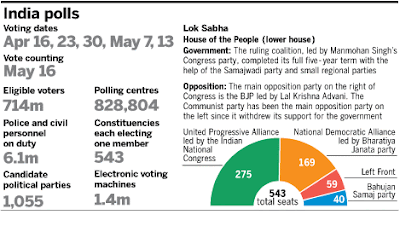
India goes to Polls

As India goes to the polls today, it is with a sense of gratitude that I sit back and take it all in. I don't care if issues at the forefront of this election are driven by caste, community or religious equations. Knowing that I live in a democracy where people have the right to choose their leaders is satisfying enough. Surely, things can get better. And maybe they will. Or maybe they won't. Either way, it is heartening to know that people have the power of choice.

For all those dimwits around the world who think Iraq was a mistake, think again, at least on this day. What you can and have been doing for years, lining up to vote, is a privilege that's been denied to a lot of people around the world. Iraq was one of those places. But today, there too, they have the power to choose. Thank the Americans and their former president for that.

Grêler la République!

Sphere: Related Content

Wednesday 15 April 2009

Wanna decipher India? Here's how.

Marketers around the world note, this is your best bet at understanding the complexities and paradoxes that ravage India and its markets. Follow the Indian elections. Its your chance at making sense of what otherwise seems an unexplainable, non-decipherable maze.

Let me point out something that I've understood. The Indian elections in all probability will throw up a fractured mandate. In fact we can safely bet on that. The fractured outcome points to a phenomenon that has deep relevance to marketing products and services in India.

Socio-cultural settings play a very important role in influencing purchase. Its this setting that drives and reinforces human identities. Identities for people as people and as consumers. Its these very same identities that will dictate voting patterns in India too.

Note that Socio-cultural environments throw up reference groups that influence. These groups encircle the consumer and weigh him with their persuasive powers. The further away an entity is in the encirclement, the lesser its impact is. For example, the closest to the consumer is his family. What follows is friendship groups, then social class, subcultures and the end's rounded up by culture. What's interesting to note in this set-up is, sub-cultural influences are stronger than cultural ones. That is, identities are driven more by a sub-culture than culture. This is true in the consumer sense as much as it is to voting patterns. That is, consumers engage in purchases that match, propagate and reinforce a sub-cultural identity. Similarly what gets the Indian vote is a region-centric (read, sub-cultural) issue than a pan-national one. The implications to this is a fascinating study, as much as the need to adhere to its fall outs.

Want to take a product to someone in Tamil Nadu? The product and its language has to turn tamilian. Remember, there are exceptions. But one thing's for sure, if the masses is the target, local-centrism is the way to go. Wanna woo the tamilian voter? The language and the issue better be Dravidian. Pan-Indian political parties are on the wane as they can't represent local people who identify more with parties that have sprung from native soil. Again, if region-centrism is true for products and services, it has to be true for political parties too. Parties wanting to tap into the local populace must espouse issues that are local. That's the only way to connect. Of course this is a dilemma. How much to localise and that too in a manner where it doesn't affect the core character of the brand?

India as a country throws up dilemmas in plenty, for the marketer and for the wannabe leader. Its how both parties balance the pull of a region with the tempering influence of a nation that will dictate either's fortune.

Sphere: Related Content

Monday 13 April 2009

Blogger, beware!

If you are a blogger and you intend to promote a product by lying about its attributes, be warned. As part of its review of its advertising guidelines, the FTC is proposing that word-of-mouth marketers and bloggers, as well as people on social-media sites such as Facebook, be held liable for any false statements they make about a product they're promoting, along with the product's marketer.

The FTC guidelines apply only to bloggers and others compensated to promote or review a product.

Sphere: Related Content

God & Government

'The next time President Obama welcomes Muslim leaders, I’d hope he’d change the script in his tele-prompter: “Just as you value your Muslim heritage and faith, we as Americans celebrate our Judeo-Christian heritage. For our rights of life, liberty and the pursuit of happiness come not from Presidents or legislators, but from God. It’s our Christian values that have driven us to extend those freedoms to others, even if it means sending our young men and women to defend Muslim citizens in Bosnia and to free Muslims from tyranny in Iraq. It’s that same freedom in America that allows our Muslim citizens to freely exercise their faith without fear of persecution. We are not at war with Islam; we ask you to not be at war with Christians or Jews. We want to work with you and other responsible members of the international community to extend religious freedom to citizens throughout the world.” '

- Terry Paulson, 'Put Your Bet on God over Newsweek'.

Sphere: Related Content

Deadly Consumption

Can anything be more tragic than losing your life in act of consumption? That's the tragedy that befell 25-year-old marine engineer, Bhargav, who plunged to his death as the harness snapped while he was attempting bungee jumping in Bangalore on Saturday. Bhargav had come all the way from Chennai to have some fun over the weekend, but he ended up paying a heavy price for it.


Of course the organisers are to blame, as they followed no safety procedures and also did not have any medical support in case there were any mishaps. The tragic loss of life of someone so young and full of promise for the future, will have implications on the adventure sport industry as a whole in India. Consumers will think twice about buying into adventure promises. After all, what's adventure when compared to one's life?

The Bangalore incident is a real one. It exposes the abysmal lack of safety infrastructure that plagues almost every retail act in India. What's also interesting to note is an unreal-perceived loss of life can scare consumers away. Take the movie 'Jaws' for instance. In spite of the fact that advanced research has dispelled many misconceptions about sharks, in the 1970s the average moviegoer had little reason to disbelieve the way that Jaws was portrayed. The film brought the possibility of shark attack to the forefront of people’s minds, and the effect was noticeable. From coast to coast, beach towns reported a downturn in tourism following the release of Jaws. Even today, nervous references to the movie can be overheard at virtually any beach.

It will take a while before people in India will strap up to take the bungee plunge. To me, the fear of lousy safety standards in India is a real one. So its better to beware. The adventure can wait.

Sphere: Related Content

Saturday 11 April 2009

Li'l acts, Large ramifications

Grudgingly I gotta admit, the crass shoe-throwing act has hit home, big time. Jagdish Tytler and Sajjan Kumar's political careers are all but over, though I know there is nothing called 'permanent' in politics. The Congress party on its part has been smart to bow to popular sentiment and act quickly.

the shoe-throwing episode demonstrates how the Davids of the world can bring the Goliaths they face down to submission. Though the shoe incident was played out in the political sphere, it can happen almost anywhere. In the business world too, behemoth brands got to be wary of the Davids that cross their path. It may just be a disgruntled customer who could turn the nemesis. If he were to take the treatment meted out to him, public, the brand risks a mass movement that could turn nasty.

Its the li'l incidents that take gargantuan proportions. Quelling it at that scale would be next to impossible. Its better to be cognizant of the li'l things and act, than wait and pay, big time.

Sphere: Related Content

'Back Again'

Sphere: Related Content

Friday 10 April 2009

The lure of Socialism

I am not a bit surprised at the Rasmussen poll that shows Capitalism is favoured only by 53 percent of American adults. Whats even more normal (about the poll result) is that the younger you are, the greater the support for Socialism.

The latest Rasmussen Reports national telephone survey reveals that adults under 30 are essentially evenly divided: 37% prefer capitalism, 33% socialism, and 30% are undecided. Thirty-somethings are a bit more supportive of the free-enterprise approach with 49% for capitalism and 26% for socialism. Adults over 40 strongly favor capitalism, and just 13% of those older Americans believe socialism is better.

I had myself flirted with Socialism when I was younger and I starkly remember why. One, I didn't have much sense then and tended to believe things that 'sounded better'. Like Socialism meant happiness and prosperity for everyone. Two, the lack of sense coupled with socialism 'sounding and seeming' better (read, perception) was a potent combination. Potent enough to entrap me.

In effect that's what makes Socialism irresistible. Perception-wise Capitalism can't come any close to its arch-rival Socialism. Any given day socialism positions itself as the better bet with grandiose illusions. Like I said, peace and prosperity for everyone. Happiness, equality and justice on earth. The takers for this illusion are many. Count college going youth, empty headed celebrities and college professors (read, liberals) minus me, in.

The only way to get Americans drunk on the prosperity that capitalism brought to see the light is to ship them to Cuba, Venezuela or places like that. A few days of misery and voila, the truth will dawn, pronto.

Sphere: Related Content

Wednesday 8 April 2009

Who's the real shmuck?

'Okay, I’m not holding my breath. But the left’s ability to act hatefully while in the very act of accusing the right of hatefulness does point to yet another of the many ways the media skew our political discourse. In the mainstream media—the left’s media, I mean—the standard for what is hateful is completely different for the right and left.

Jon Stewart shouts the F-word on air at Governor Sarah Palin, oh, what a witty fellow he is, how outrageous, how puckishly he bends the rules!

Rush Limbaugh hopes Barack Obama’s attempt to destroy our free market system fails—honk! he’s hateful.

Bill Maher’s film insipidly insults easily targeted religious people, he’s “brilliant,” says Variety, “incendiary.”

Ann Coulter points out the fact that fatherless children are the source of most of the nation’s crime, suicide and child behavioral disorders—honk! She’s mean to single mothers. How hateful.

Hollywood makes fictional movies accusing our soldiers of being rapists, murderers and fools even while they’re in the field defending us– hurrah, it’s awards time!


Geert Wilders makes a short documentary on the actual murderous acts inspired by actual passages in the Koran. You guessed it—honk!—he’s hateful.'

- Andrew Klavan, 'Honk! You’re Hateful.'

Sphere: Related Content

Why Michelle Obama can't sell magazines

It doesn't matter that the liberal media is falling over each other to fawn over Michelle Obama, their platitudes isn't helping sell magazines that have her on as cover page and story. Before I tell you why, note Brent Bozell talking about the 'fawning frenzy';


'Imagine being Laura Bush and turning on the television and watching the absolute deluge of sticky-sweet syrup being poured all over Michelle Obama during her European debut as first lady. It is as if every TV reporter was handed a pamphlet of talking points and ordered to compare Mrs. Obama to Jackie Kennedy. NBC's Dawna Friesen gushed: "Though Harvard-educated Michelle Obama has substance, not just style, and that's what sets her apart." Apart from … whom?'

According to Adage, 'A Michelle Obama cover doesn't hurt a general-interest magazine, the numbers suggest, but it doesn't produce more than an occasional lift either. New York magazine's March 23 issue, with a cover story about "The Power of Michelle Obama," looks like it produced "average" sales, New York said April 3, although the numbers remain subject to change. When Ms. Obama appears on the cover of a magazine directed toward African-Americans, however, or when she appears with the president, sales really do seem to jump.'

Michele Obama's lack of pulling power is unlike Princess Diana who regularly helped the industry sell more copies at newsstands. The reason's country-related. Diana sold in the UK, Michelle sales must happen in the US. These are two different countries with two different set of attitudes. Americans are unlike the British. Roughly one-half of America is deeply religious and conservative, and that's not a good thing for magazines trying to tom-tom with substanceless-celebrities. One half of America doesn't care. The British en-masse need their dose of pop-religion. They found it in Diana.

Conservative Americans aren't looking for pop-fulfillment. Instead they have religion and they take to it, lock, stock and barrel. Amen.

Sphere: Related Content

Cheap Thrills, Big Payoffs

No matter what the issue, tossing a shoe at the Home Minister as a mark of protest is crass behaviour. Hats off to Chidambaram for the class he displayed, which can't be said for quite a few who take to such forms of protest.

What's distressing is the payoffs that follow such acts. Its seems there's money and even a Lok Sabha ticket that's coming the journo's way. Why am I not surprised? Most publicity material out there seems to center around acts of infamy that's lapped up big time by an even more eager public that's panting for its share of cheap thrills.

Chill, they say. I may even be admonished for my point of view by an audience that seems to be getting younger by the day and dare I say, empty-headed? Or maybe I will chill. Give me a moment though. Gotta find my funny bone.

Sphere: Related Content

Me, Myself & I

Declining an invite to be part of a Blogger meet, knowing there's been a slew of similar declines in the past, I wonder if I am sinking deeper into 'social recluse' territory. And if so, is that healthy? Mentally, I couldn't be agiler. So the latter fear can be ruled out.

Why then the reluctance to participate? The reasons lie in factors extrinsic and intrinsic. Extrinsic refers to 'socialisation' and intrinsic is in terms of 'personal motivation'.

Conforming to the appeal of what is termed a 'reference group', lies in what the group can do for an individual who sees certain payoffs in being part of that group. From a consumer perspective, its about whether the group can provide information that helps tide over the risk inherent in purchases. Groups help in comparison of thinking, behaviour and attitudes. It can even provide for an identity and legitimise the usage of products and services. This is part of the socialisation process.

Now consider the motivation implication. David McClelland in his 'acquired-needs theory' proposed that an individual's specific needs are acquired over time and are shaped by one's life experiences. Most of these needs can be classed as either achievement, affiliation, or power. The desire for any of these can dictate the factor that motivates one to act. Being part of a group can be tagged as a desire to affiliate of to exhibit power depending on whether one wants to participate or take control, within the group. The need for achievement on the other hand sees a departure from affiliation and a desire of wanting to be left alone.

Back to me, now. Being a social recluse suits me fine. The payoffs seem worth it, though I may be blind to the lost opportunities. For the moment, I guess I'll risk it.

Cheers. :)

Sphere: Related Content

Monday 6 April 2009

Those arrogant Americans

'Ahhh, those arrogant Americans. First they rebel against King George III and all the crowned heads of Europe. Then they welcome tens of millions of poor and persecuted people from the Old World. Then they fail to bow down to Europe's greatest figures -- from Napoleon and Otto von Bismarck to the Kaiser, Hitler and Stalin. Then they fight a civil war, losing half a million people to liberate black people in America. Then they diss the man the BBC considers to be the greatest philosopher ever, one Karl Marx, whose followers killed 100 million innocents in the 20th century. And then, to top it all off, they liberate both the Western half of Europe (in 1946) and the Eastern half (in 1989).

What arrogance these Americans have. Either that, or a very, very -- no, stunningly -- ignorant man was just elected president -- largely because millions of benevolent voters believed that we owe black people a presidency. They may come to see that as their biggest mistake ever. In the next couple of years they will see a tripling of government debt, high inflation, a permanent loss in their personal wealth, and a major devaluation of the dollar.

Which, to judge by his recent television performance, should just make him giggle quite inappropriately, in front of God and everybody.'

- James Lewis, 'Those arrogant Americans.'

Sphere: Related Content

Yes, We can! Who's 'We'?

Hope floats, for one-half of America? Read it here.

Sphere: Related Content

RIP., Indian Coffee House & Why

While the iconic coffee house, ICH (Indian Coffee House) on MG Road, Bangalore was downing its shutters, I was 'chillin' at another that was bursting at its seams with customers (read, college going-global warming concerned youth).


I've never been the Cafe' going type. That's maybe because I lived through times where the closest you came to 'chillin' out' was when you had an ice pack on your head to get through an unbearable summer. Chatting with Namta I got to know how Cafes in Bangalore have become an integral part of youth lives. If that were so, why was ICH downing its shutters?

The answer lies in the stark contrast that's ICH and Java City, where I was at. The former, run by a co-operative had a business model focused on products and pricing aimed at the mass consumer. The latter didn't give a whit to products, instead focused on selling a lifestyle. With the kind of costs that ICH ran up, it was impossible to sustain on budget product pricing that needs consumer numbers in more than plenty. Java City and similar such Cafes depend on selling coffee lifestyles at premium prices to a target consumer segment markedly different from the one ICH pursues. We were regulars at ICH. That's because we weren't looking to having conversations about how the planet could be saved while we sipped at our Frappes. Instead we sought a wholesome breakfast, wanting to mull over 'normal' stuff. Doing that cost us nothing more than a hundred bucks. Contrast that with sipping Frappes (I know its sounds grand, but its just blended iced coffee) that costs a hundred and fifty (for two). Food cost for the Frappes I bet wouldn't be anything over twenty bucks.

Am I wistful seeing ICH go? No. Some Business models fail, where others succeed. The ones that survive and thrive are the ones that adapt and center around their target consumer segments, constantly evolving with changing consumer needs. ICH went after a consumer segment for too long with a business model wasn't financially sustainable.

Oh, by the way, I think I am gonna miss out on the ICH Masala Dosas and filter coffees served by dour looking service staff in their starched white attire and peacock plume headgears.

Wistful yet? Nah!

Sphere: Related Content

Sunday 5 April 2009

Capitalism & Politics

'Capitalism is not too important to be left to capitalists. It has to be left to them. Politicians simply do not understand. They are contaminated by a desire to redistribute, and to regulate, to keep large constituencies of non-productive voters happy. No politician has been more ruined by this, or caused more ruin, than Mr Brown: and this week he was still at it. In his drivelling speech on "morality" on Tuesday (the absurdity of which would have been exceeded only by Lord Rumba of Rio delivering it) he castigated people for taking risks. Capitalism is based on risk. The reward for risk is profit. The punishment for bad risk should be bankruptcy. Mr Brown wishes to avoid all such extremes, which is why he rails against capitalists, and bails out pointless banks with our money. Let him bask in his "triumph" while he can, for he is very near the end of the plank.

Roosevelt's New Deal failed because it hindered people from helping themselves. This welfarist event this week risks making the same mistake on an international scale, with its £1 trillion slush fund for wrecked economies. The politicians have left the stage, thank God. Now let us hope they stay off it for as long as possible, and let the people who can sort out this mess get on with doing so – whatever the risk entailed.'

- Simon Heffer, 'G20: A 'new world order' is simply fantasy'.

Sphere: Related Content

Should you vote?

It seems that every other day I am being asked for vote for something on TV. Almost every other news channel seems to tell me, I must exercise my franchise to support some initiative or the other they're hawking. I couldn't care less.


I'll tell you why. Media houses know that the only way to ensure they are part of the viewer's consideration set, when it comes securing eyeballs, is to engage with them. Engaging by default becomes a difficult proposition for a channel that's part of what is termed 'externally-paced' media. That is, media that can't be controlled by the viewer. The idea then should be to give the viewer a bit of control by engaging with him. That's why you now see a slew of voting exercises. Vote for some 'Wonder', vote to 'Lead India'... .

The list seems endless. Now you know why.

Sphere: Related Content

Saturday 4 April 2009

Most Important Book of the Year

'In light of events, Liberty and Tyranny proves timely. Its narrator urges a return to basics. Republicans must learn to speak the language of conservatism and offer the public a true choice at the ballot box. Watered-down statism — such as the kind hawked by Senator John McCain last fall — is a recipe for permanent Republican oblivion and will allow our country to devolve into an East Germany of the mind.


Levin urges fidelity to the Constitution, devotion to federalism, and the adoption of a hard, rather than conciliatory, line with environmentalists and radicals of every stripe. His positions should be taken seriously by everyone associated with the Grand Old Party. Republican Chairman Michael Steele has already endorsed the book, and hopefully more rightist officials will discover its merits in the future.

Put simply, Liberty and Tyranny invigorates. It provides ammunition and clarity for those who oppose President Obama and socialism in all its deceptive forms. Unfortunately, the first step in using the book as a catalyst is successfully securing a copy, and that is a bit of a challenge at the moment.'

Sphere: Related Content

Who counts?

'What our Indian politicians lack, however, is the mastery over technology that Barack Obama’s team showed throughout his campaign, both proactively and in terms of damage control. Even though sitting MP Milind Deora is mobilizing his constituents through SMS updates; even though Advani keeps a blog; even though I received an SMS from the Advani campaign stating that he was going to make every girl child a “lakhpati” (very rich); in the end, we IT-savvy voters are what is called a “niche segment” in India.

We count, but not really. It is the rural voters, those teeming masses in the swing states, that have politicians up at night, and cause them to play chess games with regional parties such as the DMK or AIADMK. Because in the end, getting the vote, like predicting the box office, is not an exact science.'

- Shoba Narayan

Sphere: Related Content

Indian roads and the existence of God

En route to work this morning, travelling on Hosur Road, I had the good fortune of swerving away from a collision that involved the car in front and a vehicle that cut across its path.

Traversing Indian roads, if you manage to get back home in one piece, do me a favour. Sit down, and mull over why you are unscathed. It ain't your driving skills, for sure.

Its divine intervention. No more, no less.

Sphere: Related Content

Evening Star


This one's for you, Shobachi :)

Sphere: Related Content

Friday 3 April 2009

In politics, 'Independent' means 'Positioning'

'Some cynicism is in order, but, net-net, methinks we should wipe the smirk off our gobs, and take note of these comets with the glitzy tails. Urbane independents have usually been misfits, but it could be different this time. Not because the likes of Meera Sanyal, Capt Gopinath or the ophthalmologist Mona Shah, who is also eyeing Mumbai South, are different but because the times manifestly are. Even if they lose their deposits, they will have deposited a new, non-ignorable agenda on political consciousness...

What Ms Sanyal, Dr Shah and Capt Gopinath represent is the new assertiveness of the urban middle class. This is no longer the faceless, voiceless, spineless nonentity of Indian polity. Its members have found all their hitherto missing body parts for reasons bad, but also good: economic liberalism, urban ascendancy, knowledge power and the go-getter service sector. Naturally they wouldn't be seen dead in some sloppy, one-size-fits-all political outfit. Now they have their custom-tailored candidate.'

Really, Ms. Karkaria? They represent the 'assertiveness of the new urban middle class'? Or are they brilliant marketers from the 'prosperous class' who have spotted a 'white space' they can fill? A white space that's glaringly evident, the middle class' disenchantment and all.

The idea behind being an 'independent' candidate has everything to do with a marketing concept called 'positioning'. It about creating an identity that's stays a million miles clear of the default taint that an association with any political party brings. After all, isn't the citizenry pretty upset at the political class? Never mind, we voted them in. Never mind, the fractured mandate that's always turned in reflects our collective belief that 'our' kind is what can save us and fulfill our aspirations. When I say our kind, please ensure that you've got caste, religious and ethnic equations firmly entrenched in your mind, because that's what I am talking about.

Surely, its interesting to see the likes of people mentioned by Ms. Karkaria making a foray into politics. That they care about the people, and that's why they are in, sounds a bit far fetched. After all, service isn't the motto in any activity where the player tries to maximise his payoff. But surely I am willing to make an exception this time. I sincerely hope post elections they don't get the smirk back on my face. That's if they win.

Sphere: Related Content

Brands can dictate judgements

Without taking anything away from the musical genius that A R Rahman is, I have to say, listening to Indian designers waxing eloquent about how his music takes you to a different level, I couldn't suppress a chuckle. That's because the TV news story on fashion shows in India, had these designers choosing Rahman music for their shows, and then swooning over it, despite me thinking the song I heard on the ramp felt as if the singer was in pain or maybe the song was about someone in pain.

Now I have no idea if it was a Rahman song. All I remember was that the song was about some flower, sung in manner that was excruciating. For the singer and me.

Before I miss the point, let me state what I intend to. Rahman's Oscar winning music has been accepted as not being his best. Yet the accolades for his music just doesn't seem to end. That's because the response to his music can't at least for a while be objective. The Rahman persona towers strong enough to affect most assessments. Especially after his Oscar win. Anyone listening to Rahman wouldn't daresay it sounds like someone's in pain. How dare anyone say that!

Brands that have built incredible levels of equity for themselves, will then start dictating judgements based on that equity. It wouldn't really matter that at times the brand would mess up. Even such mess ups would be seen as near perfect.

The lesson here is, as much judgements by consumers dictate levels of equity enjoyed by brands, the reverse is true too. That is, once an equity is reached and accepted by the consumer, the brand has the upper hand and can influence judgements. The truth will most probably be never told or even if someone dare say it, would be summarily rejected.

The truth is, it would take a little boy on his father's shoulder to exclaim, 'The emperor isn't wearing clothes'. Only then can we behold reality.

Sphere: Related Content

Thursday 2 April 2009

Consumer relationships are about trust

It doesn't matter that in the first place it was government intervention that brought down the now gone financial institutions, to the man on the streets, private businesses are ones that can't be trusted. This loss of trust in private institutions has seen the citizenry flock to government backed financial firms.


Like I said, this despite the truth. Note Walter Williams, 'The blame for our current financial mess rests with government, with the major player being the Federal Reserve Board keeping interest rates artificially low and the congressional and White House market interference in the name of more home ownership. In the clamor for more regulation over our financial institutions, has anybody bothered to ask whether people in government know what they're doing?'

Take India as an example, to see this shift in trust. The State Bank of India is now flush with deposits made by people who have pulled it out of private banks they used to bank with. Consumers have shifted tens of billions of dollars to India's state-run banks amid the bailouts of the world's most sophisticated financial institutions and concerns that global problems could infect India's private-sector banks. The fallout? State-owned State Bank of India is lending like the global credit crisis never happened as it looks for places to park billions of dollars in new deposits. Its is on a lending spree, cutting interest rates on loans, snatching customers from competitors and doing its part to prevent India from getting stuck in the global slowdown.

Sphere: Related Content

Wednesday 1 April 2009

Brands in use are brands that talk

All marketing communiques are aimed at building positive attitudes within consumers toward the communicated brand. Initially its perceptions that consumers form when exposed to communiques, which then gives way to learning, finally culminating in brand attitudes.

The most potent of stimuli (communique) is the when the brand's in use (by consumers) and is visible to other consumers. This can either generate a host of goodwill or can even sound the death knell to a brand. Take the Tata Indica for example. Seeing it on roads, being driven as a cab can become its undoing, at least with families that are looking at buying a car. Who would want to own a car that's driven around as a taxi? Especially, when on the roads, every other cab seems to be an Indica.

Brands in action are stimuli that marketers have no control on. Because its now the property of consumers who own it. Marketers must hope and pray that in the hands of those consumers their brand speaks in manner that gets other potential consumers flocking to it, in droves.

For the Tata Indica, I for one, don't see that happening. At least till the time its driven as a cab.

Sphere: Related Content

Who's bad?

'How many movies on the evils of Wall Street do you think are now on the drawing board? Demonize the wealthy to create class warfare, deliver a message that corporations routinely take risk to enrich themselves and the few, while the rest of us suffer the consequence of their bad bets, make folks believe that only government is fair and on their side, and Democrats are the party of fairness (the Republicans, of course are assigned the role as the Party of the big banks and Wall Street, who ripped us off, and deregulated the financial industry to accomplish this).

Let us disregard all those contributions to Chris Dodd, Barack Obama, Chuck Schumer, and the Democratic Senate and House campaign committees from AIG, and Wall Street firms. Let us ignore the role of Barney Frank in the mortgage mischief of FNMA. Let's forget about FNMA CEO Franklin Raines, walking away with $120 million in a severance package (where are those demands for payback of bonuses from executives who looted the nation, and cost it tens of billions in bailout money?).'


- Richard Baehr, 'Class War in America'.

Sphere: Related Content