Thursday 29 April 2010

Who's to blame?

'How is it possible, after being the victim of a brutal rape, to absolve the perpetrator of guilt and point the finger at men of another color who are nowhere near one’s body? This projection is absolutely stunning and self-defeating.

The man who committed this crime committed it for his reason and his alone. Without holding him to account, what hope of change is there? If a person cannot own his behavior, he cannot change it.

This sort of rationalization would absolve white slave owners, by the way. They were simply victims of cultural thinking at the time. And the patriarchy? A remnant of twisted religious extremism.

No one would be responsible for any action at any time, anywhere. There is, after all, a context for every crime.

At the root of this absolution is a desire to push personal responsibility on the collective. Unfortunately, the collective was not in that room that night. One man raped one woman.

He alone is responsible. Excusing his behavior is a moral travesty. A society unravels when evil cannot be named and shamed.

Forget collective guilt. It is a collective shame that this sort of thinking permeates liberal thought. This belief in action will utterly destroy society should it go unchallenged.'

- Melissa Clouthier, 'Who’s to Blame When a Black Man Rapes a Woman?'

Sphere: Related Content

Communicating Low Involvement brands

'Most FMCG products are low-involvement products and are required by consumers on a day-to-day basis. The buying pattern is more habit-led as compared to high-involvement products whose purchase requires more research. And hence, within a 30-second spot on TV, the advertiser previously was more concerned about communicating the functional benefits of the product, which left a minimal scope for creativity and therefore led to a fatigue in advertising. However, since creating a unique brand promise was/is difficult (considering that most of the products in one category provide more or less similar functional benefits), advertisers since then have gone radically ahead and created unique brand imagery, in fact moving away from the actual qualities of the product.'

- Savreen Gadhoke, 'The Creativity Abnormality'.

Sphere: Related Content

Its the product, stupid!

Calling it a disappointment would be an understatement. Haier's latest 'You inspire us' jingle driven TV commercial that features something on lines of the non-rock movie, 'Rock on', is a sore to the eyes. Of course, Haier's objective was to get the jangling jingle to remain in our long term memory via the act of cognitive itch. I must say they have succeeded, but have they a communicated the brand in a manner, to build equity? I think not. I also think this is because the guys who came up with communique fundamentally misunderstand the way durables are bought.

But first tings first. I am a Haier admirer. Its been my favourite case study that I take to class. Zhang Ruimin's turnaround of a refrigerator company into China's most admired business firm is the stuff of legend. Also, Haier was the first home appliance brand in the world to sponsor the NBA.

Haier's entry into India was but natural. Yet what Haier's got wrong is the way they've communicated the brand in India. Durable buy is high involvement buy. Two factors precede every other when it comes to a choice of durable brand, for consumers. Product quality (perceptions) and price. Building a brand would therefore mean focusing on communicating the product sans the price, considering we're talking a lifestyle brand. Of course, this isn't easy knowing the factors of differentiation in this category is minimal. Yet focusing on product design and its aesthetically functional capabilities is I believe the way to go. Lifting a durable from its mundane form into one that's aesthetics driven doesn't mean taking it into jingle territory, instead is about going the 'Apple-lifestyle' way. And remember that can't come at higher prices.

Haier's a great company and is here to stay. But staying also means communicating right. For its sake I hope Haier won't be about a jingle, but a sophisticated lifestyle product at a superb price. For that's what will bring the moolah in.

For sure, in India.

Sphere: Related Content

Tuesday 27 April 2010

The right to produce, to consume

Can you believe it? The idiots tried to shut the country down because they were protesting against price rise! The tragedy is, they succeeded in certain states in the country.

Can you believe it? They try and shut down the one activity that's at the heart of low prices. Production and consumption. The more producers produce, the more consumers consume, prices drop. Yet its that one critical act of production-consumption that was shut down across six states in India. All in the name of protesting against price rise.

Of course, big manufacturers will be able to absorb the loss caused by the hartal, but what about the small scale producer-seller? His revenues for the day are gone forever. Many a small business owner (include kirana stores, roadside sellers, push-cart traders) would have had their families go hungry today because they were forced not to manufacture or sell. What travesty of fundamental rights!

The right to protest is fundamental to a democracy. But forcible stoppage of the act of production-consumption under the guise of a protest is downright illegal. More importantly its a travesty of justice, of rights.

Our rights to produce and consume.

Sphere: Related Content

The next iPhone uncovered


Read Gizmodo's complete story on the next iPhone here.

Sphere: Related Content

India's Urban Awakening

Opportunity of India's urbanisation to 2030 -

  • 5 times - the number by which GDP will have multiplied by 2030
  • 590 million people will live in cities, nearly twice the population of United States today
  • 270 million people net increase in working-age population
  • 70 percent of net new employment will be generated in cities
  • 91 million urban households will be middle class
  • 68 cities will have population of 1 million plus, up from 42 million today; Europe has 35 today
  • $1.2 trillion capital investment is necessary to meet projected demand in Indian cities
  • 700-900 million square metres of commercial and residential space needs to be built- or a new Chicago every year
  • 2.5 billion square metres of roads will have to be paved, 20 times the capacity added in the past decade
  • 7,400 kilometres of metros and subways will need to be constructed- 20 times the capacity added in the past decade.

Access and read the McKinsey Global Institute report titled, 'India's urban awakening: Building inclusive cities, sustaining economic growth', here.

Sphere: Related Content

Monday 26 April 2010

The simplest ain't the easiest

Urmi left the corporate world to follow her passion. Dance. She's now at the Daksha Sheth Dance company. When I applaud her for following her heart, she shrugs it off, and tells me what turns out to be immensely thought provoking. She says, what she's done may not have been the easiest of things to do, but was the simplest of all.

'Following one's heart is actually the simplest thing one can do. It may not be the easiest, but it is one of the most simple things.'

Reminds me of what Marketing should be, to business firms. Though not the easiest of acts, Marketing is the simplest of orientations to have. One that ensures everything a business firm's about, revolves around the consumer.

Its practice ain't easy. Far from easy, I'd say.

Sphere: Related Content

Sunday 25 April 2010

The society we are

'So, the truth is, the reasons Pushkar has been pilloried lie elsewhere. Imagine for a moment that instead of Pushkar some nephew of Tharoor had been given sweat equity. Would the media have ferreted out every last detail about his girlfriends and colour of bedsheet — imagined or real? Pushkar says the last fortnight has been akin to a medieval witch hunt. She is right. A deep and unthinking misogyny has underscored all the reporting on her. Her real crime is that she is an attractive 46-year old widow, who is bright, vivacious and hot — in the way only those women can be, who have a comfortable relationship with themselves; who understand that beauty does not preclude one from being kind; or protect one from sorrow. If the media had wanted to try the two for financial impropriety, it should have stuck to doing that. Instead, all of it has become an ugly spectacle about a society trying to decide what women are allowed and not allowed to be. Ambition, sass, and self-assured sexiness are clearly high on the list of India’s penal code for women. This is why Pushkar has been asked by “well-wishers” to stay out of view. This is why she’s in the process of being tamed for Indian public life. The story of how Sunanda Pushkar has been treated then is not the story of just one woman: it is a parable about the society we are.'

- Shoma Chaudhury, 'The Parable of a Vamp'.

Sphere: Related Content

IPL India's pride? What 'bout Lux & Lifebuoy?

All this talk about Lalit Modi being the marketing genius is hogwash. Two reasons why. One, IPL wasn't the pioneering one as a new cricket format in India. It was ICL. Two, IPL ensured it remained a monopoly. They called ICL 'unsanctioned' and used the 'ban' threat on ICL players to shut it down.

Since when is a monopoly considered a marketing triumph?

A monopoly like IPL should instead be seen for what it really is. A house of conniving convenience that has the usual politician-private business nexus to ensure its the only one around. Who's the biggest loser in all of this? The citizen who's now forced back into socialist days where his only choice used to be a monopoly.

The IPL franchise owners on their part are playing the 'marketing card' to near perfection in defending Lalit. It shouldn't be no surprise they are throwing their weight behind Lalit, because they have seen their team valuations rise astronomically. Preity Zinta last night on TV followed in the traditions of her other franchise owners by calling IPL India's pride. In doing so she played smart by making it seem as if the league's not about the money she or the others were making, but about how it was for the millions of cricket fans in India. Her 'take' is jarringly smart. Because the marketing rule says that products and services aren't about the companies they come from, or make money for, instead they're about consumers. Preity turned the marketer by playing an emotional card in presenting the IPL circus as India's pride. Something for the people, of course, not for us.

If IPL, the product from a bunch of self serving private parties and politicians is the pride of India, what about the likes or Lux and Lifebuoy? I know they are soaps. But they've been around too. Far longer than IPL and serving the Indian pretty well. Shouldn't they also be presented as India's pride?

I say yes. What say you?

Sphere: Related Content

Saturday 24 April 2010

Consume more this Earth Day

'Happy Earth Day! If you care about the environment, you should observe this special day (and others, if you can afford it) with a joyful spree of consumption, especially buying goods from people in poor countries. Writing a few letters to legislators extolling the benefits of free trade wouldn’t hurt either.

We all want to live in a clean, healthy environment. But only people whose basic needs are met, who have adequate housing, food, clean water, education, healthcare, and economic opportunity can take the time to care about protecting their environment, and can afford to do so.

By engaging in trade with other countries, we help them grow wealthier, helping them to afford environmental protection, while we help ourselves by gaining access to goods and services that it might be impossible, or ruinously expensive, for us to manufacture ourselves.

So go have some coffee, and help Africa grow wealthy enough to protect the environment. Maybe buy some nice wooden furniture from Africa or Asia. Buy a nice sari from India, or a fine tea set from China.

The sooner people grow wealthy, the sooner the environment will benefit. Now, get shopping!'


- Kenneth P Green, Enterprise Blog.

Sphere: Related Content

Held

Sphere: Related Content

Prism Salvation: Social Media Domination

The other day, Mike Saunders invited me to answer questions from students of his Consumer Behaviour class at the Maranatha Baptist Bible College.

You can listen to the Q&A here.

Also, Mike's got a great book, 'The Prism Salvation: A 3-Step Solution to Social Media domination for Busy Business Owners', that you can check out, here. There's even a free chapter (for download) that you can get from Mike's book.

Sphere: Related Content

Friday 23 April 2010

Marketer, know me, the 'altered' me?

The Family Life Cycle illustrates moves across stages through which many families pass. For me, the move's now been from bachelorhood, to young married without children (honeymooner), to young (am I?) married with children (parenthood).

Tell you what, the one 'move' that's drastically altered my life has been the last one. To being a parent, a father. Of course, each of the moves has been an incredible journey, but the last one's the one that's had me reconfigure my psyche. Completely. Having Jaden has been a life altering experience for both Alphy and me. And its only been getting better, lovelier and scarier. There's so much of Jaden in everything that we do. From buying a new car, to travelling, to visiting places, to eating out, to shopping at retail stores, to going to hospitals, to reading books, to watching programs on television, to almost everything. Every consumption act of ours sees us taking Jaden into consideration. Our choice of retail store depends on which one's more conducive to kids. Can Jaden move about in the store freely, is there the kind of stuff he eats, is there a play area, those are the questions we ask before we make our choice. Ditto for us picking a place to eat out. How friendly are the service people in the restaurant, is there a baby chair if we want one, and so on.

Note, its not just about products, its about marketing communiques too. If a marketer wants to connect to me, he's got to get his copy right. Stuff like, 'Smart may have the brains, but stupid's got the balls' is the kind of communique that makes me want to throw up. Of course, it works for the nincompoops who are the target consumer segment, but with me, nah. The metrosexual mumbo-jumbo needs to be kept miles away from me. Instead if the marketer wants to sell me a shirt, tell me its the kind I can wear when I wickedly do the splotchy paint job with my three year old. That would get me to buy.

I am not sure if marketers have really understood fathers. That may be because they don't know what its like to be one. For marketers to get to the likes of me, they've got know my altered psyche. One that's been re-configured irreversibly. Marketers need to step into my shoes and know what's it that drives me, now.

If they can , and if they do, I am most vulnerable to their guiles. And that shouldn't be surprising because, after all, I am a father.

Sphere: Related Content

Wednesday 21 April 2010

Paisa Vasool

'Paisa vasool. The ultimate Indian idea of good value; not to be confused with miserliness. Paisa vasool means that the purchased item was worth its price. It indicates a satisfaction in extracting every drop of consumptive liquid from each paisa. When you wring the act of consumption dry, and leave no discernible residue, it is then that you feel the warm after-glow of paisa vasool...

This ability to see utility in all its dimensions in any object and to not rest till every ounce of it is exhausted, has perhaps more to do with the ingrained cultural memory of scarcity, than with a real need for economy. We may not mind paying more, but our paisa must always be vasool.'

- Santosh Desai, 'The Dhania Factor' (Mother Pious Lady).

Sphere: Related Content

Tuesday 20 April 2010

Nick Clegg can thank perceptions

The difference between Nick Clegg and the rest is the difference between perception and reality. Despite being the mirror image of another disaster who made it to the top job, Nick has seen a surge in his popularity.

The reason's the same as that of Barack. The Conservative and Labour party is stark in public memory. Liberal Democrat isn't. That bodes well for Nick. Because the utopian perfection that he paints, though an illusion, is believable as it operates in perceptual territory.

Barack Obama was the very same illusion who won because of perceptions. Reality as it now unfolds in the US is proving to be acutely unpalatable. After the US, its now Britain's turn.

Pity.

Sphere: Related Content

Shashi Tharoor's about aspiration, not naivete

Various adjectives have been used to describe Shashi Tharoor. From naive, to dubious, to corrupt, to many others. But I think I spy envy despite these characterisations. After all, how many of these commentators would have known the word 'interlocutor'? That's ample reason for envy.

Commentators on TV seem to think Shashi overplayed his hand. They feel his suave personality wasn't fit for India politics. Of course, it wasn't, but then is that reason enough to morph personality? Because you see, it isn't about appearing the country bumpkin that gets you your place in Indian politics, its your ability to connect with your voter. Shashi's target voter is the urbanite. And he is teeming with aspirations. For a better life and a better being. Who epitomises it better than Shashi?

For the urban populace, Shashi is the aspirational brand. They want to be like him. They want to have the kind of pedigree he has, the kind of job he had, the kind of vocabulary he sports, and of course, the looks and charm he brings. Should it therefore be surprising that Shashi's got a fan outpouring on the Internet, post his exit? The likes of Pranab, Antony, Ravi Shankar Prasad, and Rudy may be perfect for Indian politics, but who wants to be like them? The likes of Shobhaa De, Suhel Seth and Vinod Mehta are fine for loudmouth TV, but who aspires to be them?

Shashi is what they want to be.

And therein lies a Marketing lesson. Of segmenting, targeting and positioning. It isn't about being a status quo bore and appealing to your peers. It isn't about, as Ashis Nandy said, appearing dumber than you are, in Indian politics. Instead, its about knowing who you target as voters/consumers and then turning aspirational for them.

Shashi Tharoor is the aspiration for the moment. That's smart, and may I say, far from naive!

Sphere: Related Content

The 5000 Year Leap: Principles of Freedom

Sphere: Related Content

Liberal Q & A: The easiest quiz ever!

Global cooling? More government control
Global Warming? More government control
Recession? More government control
Decade of Greed? More government control
Banks too picky in lending? More government control
Banks not picky enough? More government control
Too many crops? More government control
Not enough crops? More government control
Too many poor people? More government control
Too many rich people? More government control
Overconsumption? More government control
Underconsumption? More government control
Cost of energy too high? More government control
Cost of energy too low? More government control
American industry too profitable? More government control
American industry not profitable? More government control
American standards for medical care too low? More government control
Cost of American health care too high? More government control
Kids too skinny? More government control
Kids too fat? More government control
Schools producing a diverse spread of competence, ability, and interest? More government control
Schools producing a mediocre homogenized student with hardly any competence, ability, and interest? More government control

- Michale C Keehn, Libertas Per Adamas Blog

Sphere: Related Content

Are you a Doer-Thinker-Doer?

Anita and cousin spar over the need or non-need of an MBA education. I listen to the story and think, 'they've missed the point'. I think the debate should be more about the need or non-need for classroom learning. Never mind what kind of degree that turns into. Sure, the MBA course has attracted more criticism than others over the fact that its the closest to be being industry relevant, and therefore its need to be application oriented.

Too many times I hear about how a classroom simulated MBA does not work in the real world. The ones who opine, let me safely guess, work in the industry and don't have an MBA. Or have an MBA but the lack the ability to either spot or try a conceptual application within the workplace.

Tell you what, you don't need to step into a classroom should you have what it takes to be part of an industrial activity that culminates in a product or service that consumers value. On the other hand, sans a classroom entry, should you find yourself at sea in this industrial value chain or are miserable at churning out the same cr*p every day, I'd say don't hesitate, step in as quickly as you can. Also remember no industrial chain operates in a static environment. Also, as much as the environment changes, so do competitors. This means other chains will come in, compete better, thus deliver greater value to consumers. This may be because they have within them competent intellectual capital. People who are what I call 'doer-thinker-doers'. Having such people means you foster what Noel Tichy calls 'Teaching Organisations', where everyone's a teacher-learner.

Simulated classroom environments turn a fertile breeding ground for varied perspectives. It allows for one to break out of what is otherwise 'boxed-in' thinking, because now you have others disagreeing and debating. For me, working long in an industry and not being exposed to a classroom environment is a no-no. In fact, I think its fatal, because it dries up the ability to think outside of what one's been doing, almost forever. Walk into organisations today and in all probability you will see staid thinking, repetitive working. You will see how personnel conspire to maintain status-quo. Radical thoughts, if presented wouldn't see the light of the day. Of course, there are firms out there that are different. But then they are few and far in between.

The ability to combine thinking that's classroom driven, and action that's industry driven is what will guarantee success for the future. Take CK Prahalad for instance. His advocating that companies look at the bottom of the pyramid consumers as being sufficient and feasible for a sustainable business model broke conventional thinking that believed they weren't moneyed enough to go after. Industry bigwigs soon saw the potential that BoP consumers held. They then tweaked their 4Ps to tap into this potential, with success.

Industrial applications are important. So is classroom thinking and debating. A combination is what produces and nurtures someone into a doer-thinker-doer. And that, I believe, is intellectual capital of the future.

Sphere: Related Content

Saturday 17 April 2010

Friday 16 April 2010

Who cut his face to spite his nose?

Lalit Modi, despite tom-toming himself to be this Marketing whiz kid reminds me of someone who cut his face to spite his nose.

Almost every politician, business house and cricketer involved with the IPL is now scrambling to shut the controversy down, so they themselves don't go down. It reminds me of the concept of tacit collusion where firms conspire so they can rig the consumer market, and not knife each other.

Will IPL come down like a pack of cards? These are still early days, plus I for one think the country's got weightier issues to care about.

Sphere: Related Content

Thursday 15 April 2010

Shaming Shame

'Shame is an externally dictated response to a societal construct, imposed by the group on an individual. It proscribes what you must not watch on TV, or read only with a torch under the covers, or listen only when others aren’t around; it forces the length of your hair, beard, and even skirts, and its absence makes you feel safe to take off your veil because no one will look and tell your brothers, parents and elders—the keepers of the community’s values. Rushdie defied that, and in The Black Album, Kureishi cheered that defiance, by showing the gradual transformation that his protagonist Shahid Hasan underwent, opting for freedom over blind faith.

In Behud, Tarlochan Kaur Grewal (Bhatti’s alterego) celebrated her victory differently: Even as a man burnt her manuscript, and the image on the wall showed a window engulfed by flames, letters of the alphabet defiantly fled the fire; a photocopier began spewing out pages of her manuscript—like those people on an island at the end of Ray Bradbury’s Fahrenheit 451, who recite the books the authoritarian state has outlawed and burnt.

That, in the end, is the best weapon against the bigots: to remember, to share, and to tell these stories, again and again, so that even if they burn the books, our stories survive.'

- Salil Tripathi, 'Shaming our liberties'.

Sphere: Related Content

Wednesday 14 April 2010

What brands can learn from Shashi Tharoor

The Shashi Tharoor saga continues. The latest is Tharoor talking to Barkha Dutt of NDTV. And the class act that Shashi is came through loud and clear, in the interview.

Amongst the crassness that dominates both politics and business in India, Shashi stands tall. More so as he is such a contrast. He can talk, most can't. He is suave and sophisticated, and his endearing personality is such a welcome change. Yet that's exactly why he's under fire. From fellows who don't have the looks, can't talk for nuts, and for whom sophistication is as alien as unidentified flying objects.

I am glad Shashi came on mainstream media to present his version. The timing was just right. The content of his talk was strong on logic and his body language was near perfect. Shashi's interview will go a along way in establishing an image that will have as a fallout, favorable perceptions about him. Of course, the baying for his blood will continue. But to the larger viewer, Shashi would have come off as a forthright, decent man. I for one, believe he is.

Communicating to a target audience is a must for brands. More so when there's negative publicity flying thick and fast. Of course, at times staying silent may also be the right response. But when there's a need to talk, brands must. What they must get right is the timing, content and the image.

Shashi got it right. And that's because, as he says, he had nothing to hide.

Sphere: Related Content

Why IPL scores

As I listen in on the IPL award related press conference being addressed by Lalit Modi, I gotta say, I have to hand it over to this guy. Lalit's taken the most boring of sports, Cricket, and turned it into a money-making machine.

The reason, as much as its about a marketing juggernaut behind IPL, is also about India and the sports scene here. For a billion people, there isn't a single team sport at which the country does well. Thank God the game of cricket was invented by the English. Its boring nature is thus explained. It should therefore not be a surprise that not many countries around the world took to it or played it. India thus stood a great chance at doing well at the game. It did. A billion naturally took to it.

Thank the stars also for the fact that there are Indians around the world, living in other countries, dying to connect to something's that's Indian. Food aside, what's left is cricket and song n' dance Bollywood. Currently the two have joined hands in the jamboree called IPL.

For now, close to a billion eyeballs are buying in.

Congratulations.

Sphere: Related Content

Public Choice Theory


Watch Public Choice Theory in Educational  |  View More Free Videos Online at Veoh.com

Sphere: Related Content

Tuesday 13 April 2010

Who's like a premium brand in a kirana store?

I am amazed at the hullabaloo on the latest Tharoor controversy. The Khap panchayat dares the courts, angry mobs ransack a hospital in Kolkatta, and prime time new channels present in the most Bollywoodian of fashion as borne out by the permanent comedian on TV Arnab Goswami, who's got equity in the Kochi IPL team!

For crying out loud, who cares?

IPL is a private jamboree intended at making money by getting people to watch what I've always said is the most boring of sports. Of course, now presented in a baseball-like fashion. Now the real reason behind Lalit Modi crying hoarse is his chunky money and influence pie taking a hit because Kochi gets a team and not someone he favoured.

Tell you what, Shashi Tharoor is like a premium brand in a kirana store. Too much of class and sophistication. Too many beautiful women at his arm. The kind of guys we find in our parliament can't get a mile within either class or lovely women.

Is it any wonder then politicians too want to stick it to Tharoor?

Sphere: Related Content

Monday 12 April 2010

Sunday 11 April 2010

Consumer Rights & Responsibilites

'The benefit of a tax is that it affects you and your competitors at the same time, so you all benefit from doing the right thing, as opposed to having to compete against someone who doesn't care as much as you do.'

The problem I have with Seth's take on the Sweet soda tax is twofold. One, the added tax if passed on to the consumer would mean higher prices. What if that brings consumption down? Of course, that's the idea. But then, you're barking up the wrong tree. Which brings me to my second point. The burden of reduced consumption mustn't be put on producers but on consumers. I mean, if the right to consume is theirs, the discipline to resist consumption should surely be theirs too. Plus, why should I pay more for your indisciplined obesity?

Taxing the producer to save the consumer is pretty dumb. Plus it only breeds ninnies looking for excuses.

Sphere: Related Content

IPL's googly: Jingoism turns regional

'There's a third observation: the Englishman and the Australian, and the South African also applauds the Indian batsman's boundary, the Indian bowler's wicket and the Indian fielder's catch. The Indian's cheering, all of us know, ceases when the other side does well.

It is as if a switch has turned the audience off, so consensually does the pandemonium end. Why does this happen? Our applause isn't mere appreciation of sporting ability: it is nationalism, and it comes from our desire that India should prevail. This is fine, but it also includes the caveat that the other side mustn't do well, and that is jingoism.

There is the applause given to a batsman for his century, true, but that is exceptional. The silence that receives the opposition's boundaries, or our wickets going, is the rule. This is the cricket viewing all of us were familiar with.

And then the IPL appeared, and suddenly it's different. Why?'

Read Akar Patel's complete article here.

Sphere: Related Content

It's too late

Sphere: Related Content

Saturday 10 April 2010

Project Rebuild Tiger

'Except Woods didn’t suffer. His life was a nonstop party, for years. What he did was cause others to suffer. He isn’t a victim; he’s a degenerate. His brief hiatus from golf and his stay in “rehab” are mere theater meant to allow time for the jokes to die down and to rebrand him as a soul-searcher.

What soul? Woods didn’t fall in love with someone other than his wife, didn’t commit an indiscretion or two, didn’t prove he’s “only human.” On the contrary: His sexual exploits are practically superhuman. They required planning and tactical brilliance and elaborate deceptions and a tireless, all-consuming devotion to adultery. They aren’t “a mistake.” They reveal the true essence of who he is: a revolting scoundrel. It doesn’t matter how much time he spends parading his penitence. His hero credentials stand permanently revoked. Don’t let Nike fool you into thinking otherwise because they need him to sell their super-duper high-performance sweaters.'


- John Boot, 'Project Rebuild Tiger'.

Sphere: Related Content

Ray for Carly


"A boss isn't paid more than a subordinate because he or she is better. A boss is paid more than a subordinate because the boss has greater responsibilities. One of those responsibilities is to stand up for people when it's necessary and to shield them from things they shouldn't have to deal with."

- Carly Fiorina, 'Tough Choices: A Memoir'.

Sphere: Related Content

Thursday 8 April 2010

What's common to Electricity Board & Sellers?

The horrible power scene in Bangalore reminds me of sellers.

When the load shedding's applied by the Electricity Board, its done dot on time. When the power's supposed to be back, usually after a lifetime, it takes its sweet time. Meanwhile we sweat it that big bit longer.

Sellers, at the time of the sale go on an overdose of saccharine promising us the moon. We acquiesce and buy. Then when its time for a service, if you can get past the call center, consider yourself lucky. In fact tell you what, it'll be quite a while before you can have them respond to your calls for help.

Our LG refrigerator's got a broken freezer door for as long as I can remember. Where are the LG service guys? Dunno, they've gone into hiding I guess!

Welcome to a citizen and a customer's life.

Sphere: Related Content

What Is Barack Obama?

'I don’t think that just putting Obama on the couch is the best way to understand him.

Put him in the classroom instead. Because he’s the stereotypical American undergrad at a stereotypical Ivy League college in the age of political correctness.

He doesn’t much like America or Americans, or the “former colonial powers” like Britain. Like so many would-be intellectuals, he admires lefty writers and screenwriters and actors and actresses. He likes the downtrodden, like the Palestinians, but he’s overcome with awe for the occasional cool (non-Western) monarch or emperor (whether Arab or Chinese). He probably has a Che tee shirt tucked away in a drawer, don’t you think?

He doesn’t know much history (he thinks Muslims invented printing), geography (his America has 57 states), or economics (he believes you can reduce health care costs by adding millions to the public rolls).

The most important thing to this president is how you feel and what you say, not all those annoying facts (50 states, the Chinese invented printing, and you increase deficits when you spend more). And, like most students, when the debate goes badly for him, the president makes fun of his critics–when he actually lets them talk a little bit.'


- Michael Leeden, 'What Is Barack Obama?'

Sphere: Related Content

Wanna buy a Nike?

But this was even more crass. This was even more calculating. This was flat out nauseating.

"I want to find out what your thinking was. I want to find out what your feelings are. And did you learn anything?" Dad asks.

There's no answer, but it could have been: "Yes, sir. I learned to be more careful when I send text messages."

Indeed, the attempt by Nike to begin trying to craft public opinion in Woods' favor is so cartoonish it's laughable. Selling shoes is one thing, but selling moral rehabilitation is better left to those who do it on Sunday.

Maybe the people behind the Swoosh are so worried they'll lose their franchise they're desperate to try anything. Or maybe they've just figured out they needed to do something—and fast—because people aren't buying what Woods says, either.


- Tim Dahlberg, 'Tiger wants you to forgive, and to buy new Nikes'.

Sphere: Related Content

Tiger & Dad in an Ad is pretty Bad


Before we rush to judging the Marcom guys at Nike as idiots for their ill timed Nike Ad featuring maligned Tiger Woods and the voice of his dead father, consider the 'Attitude toward the Ad' model.

The Model proposes that a consumer forms various feelings (affects) and judgments (cognition) as the result of exposure to an advertisement, which, in turn, affect the consumer’s attitude toward the ad and attitude toward the brand.

Lets now try and map how a viewer will respond to the latest Nike Ad. On exposure, the viewer forms both judgments (an act of cognition) and also 'feels' a certain way. My gut tells me its the affective (feel) part that would contribute overwhelmingly (over judgements) to forming attitudes about the ad, therefore about the brand. Currently as further skeletons tumble out of Tiger's amorous cupboard, disgust levels will only rise. Which means the Ad featuring Tiger looking like he's swallowed marbles, and his dad's voice will only seem in poor taste. As the lousy feeling evoked by the Ad subsides, judgements will take over. The viewer will now be incensed at both Tiger and Nike trying to exact mileage out of what's otherwise a sickeningly scandalous story. The emotions and judgment combined will only contribute to an ill-will towards Nike as a brand.

But what may still work in Nike's favour is the negative attitude not translating into a non-buy of the brand at the store. Though I think its too much of a risk that Nike's taken. The only silver lining is the brand noise this Ad will generate. Blogs, Social and Mass media will be buzzing with reactions to the Ad.

That means the Brand Nike gets talked about even more leading to stupendous levels of brand recall, should a sneaker purchase be considered. Despite that, I think its fair to go with the word 'dumb' to aptly describe those behind the commercial.

Dumb, dumb, dumb.

Sphere: Related Content

Wednesday 7 April 2010

The risk of 'Neither-Nor'

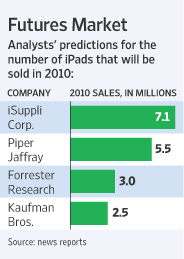
The opportunity iPad's latched on to, is the vacant product space between a phone and a laptop. Yet the risk it runs is that very same space meaning nothing, because it could turn out be neither a phone nor a laptop in the consumer's eyes.

The initial sales of iPad have been disappointing. But these are early days as other Apple products too took off after a slow start.

Its worth waiting to see which way the iPad product curve goes.

Graphic: WSJ

Sphere: Related Content

Saturday 3 April 2010

Bada Hua to Kya Hua...

The current Complan commercial tells parents they needn't worry if their kids are vertically challenged, and have to face the brunt of jokes at school. Yours truly can help them expand vertically, thus saving them of their humiliation.

Now for someone who's pretty much vertically challenged, which is me, I must say the commercial makes me wince. I remember graphically well the challenges I faced whilst young, being in the 'challenged' category. But tell you what, today its a breeze. While my vertically blessed peers look like they're going to kick the bucket (yeah, that's rude :) ), I could play Foosball with college kids and have no one notice. Though I guess the greying hair could give me away.

Back to the commercial. I think its a brilliant idea to play into the insecurities that parents carry. After all, most of 'em try and live out the lives they couldn't for themselves, through their kids. I can't imagine too many parents out there thinking genetics when they see the Complan commercial. Instead I see them remembering the Complan message, buying into the bunkum, and accordingly buying the brand at a store.

Fear and anxiety appeals work well if used with care. It may require the consumer to be the insecure kind for such appeals to work. As for parents, they're near perfect for such messages. Though the jarring note amongst it all would be parents like us who are downright proud of Jaden's vertical progress now and forever.

Hey as a closing note, for all the vertically blessed ones out there, may I remind you of what the mystic poet Kabir said, 'Bada hua to kay hua.....'

Sphere: Related Content

I can only imagine

Sphere: Related Content

Thursday 1 April 2010

What about the 'Right to Educate?'

The 'Right to Education' should be more about the "Right to Educate'. Which means to have more children in schools, government shouldn't be enacting laws that force educators to take on more children, instead it should be enacting laws that allow for more schools to be built and run. Which means the school system should be rid of the government bureaucracy that now controls it.

It doesn't matter whether its education or any other service, government intervention only makes things worse. Its private enterprises that can always better services, even in education. Like I said, the government should do nothing but make it easier for private enterprises to flourish in education, thus paving way for more children being educated.

Note Milton Friedman's take on Education,

'I believe that the only way to make a major improvement in our educational system is through privatization to the point at which a substantial fraction of all educational services is rendered to individuals by private enterprises. Nothing else will destroy or even greatly weaken the power of the current educational establishment--a necessary pre-condition for radical improvement in our educational system. And nothing else will provide the public schools with the competition that will force them to improve in order to hold their clientele.

No one can predict in advance the direction that a truly free-market educational system would take. We know from the experience of every other industry how imaginative competitive free enterprise can be, what new products and services can be introduced, how driven it is to satisfy the customers--that is what we need in education. We know how the telephone industry has been revolutionized by opening it to competition; how fax has begun to undermine the postal monopoly in first-class mail; how UPS, Federal Express and many other private enterprises have transformed package and message delivery and, on the strictly private level, how competition from Japan has transformed the domestic automobile industry.
'

Read Milton Friedman's take on the role of Government in Education, here and here.

Sphere: Related Content

I switched, I saved

After quite a while I do my grocery purchases at Star Bazaar. As usual the place is chaotic. But then there's something that's good for the consumer at the store. Across various categories of products, Start Bazaar's used a tactic that I believe will stand it in good stead. The store's got a tag above almost every product on the shelf saying, 'Switch & Save'. The tag pits Star Bazaar's private label brands with established brands on the shelf by telling consumers should they 'switch' to the store's brand they would 'save' a certain amount of money.

Did I switch? Of course, yes. Maybe not all categories, but certain ones, yes, I did. Why? Simple, because when it came to those products I didn't think brands from manufacturers were any better than the store's brands. In fact for all you know, the products inside the packages would have been the same. Which means the brands have now turned into commodities for me, and in such case what gets my buy is lower price. The store brand's priced lower.

Note, when it comes to most grocery and FMCG products, consumers make their brand choice inside the store. Its because they aren't involved with such products enough to have the brand pre-determined outside the store. In such a scenario what gets the consumer buy is compelling value proposition inside the store. Store brands at the Star Bazaar store did have such a compelling proposition through its 'Switch and Save' program.

I switched, I saved.

Sphere: Related Content